







Soundproof and sound absorb a production hall – best methods
A production hall often contains high noise levels from machines, ventilation, compressed air, and other technical installations. These sounds can cause work environment problems, stress, hearing damage, and communication difficulties for staff. Additionally, the noise can spread to adjacent premises, offices, or buildings and cause disturbances there as well. To create a safe and efficient work environment, both soundproofing – which stops sound from spreading – and sound absorption – which reduces the sound level inside the room – are required.
Soundproof walls, ceilings, and floors to stop noise transmission
To prevent noise from escaping the production hall to other areas, walls, ceilings, and floors should be soundproofed with the right material. SilentDirect MLV is a heavy, rubber-based material that effectively blocks airborne sound. To simultaneously reduce vibrations and structure-borne noise in floors or against adjoining walls, it can be advantageously combined with SilentDirect Neo or SilentDirect Polaric. Neo and Polaric function as damping intermediate layers and reduce resonance, vibrations, and noise from, for example, machines, forklifts, or impacts. The ceiling is especially important to soundproof if it adjoins other premises or floors. In many cases, insulation within the structure is not sufficient – instead, several layers of soundproofing material should be applied, or a new freestanding ceiling built inside the hall with soundproofing and vibration-damping layers.
Use sound absorption to reduce reverberation and improve the work environment
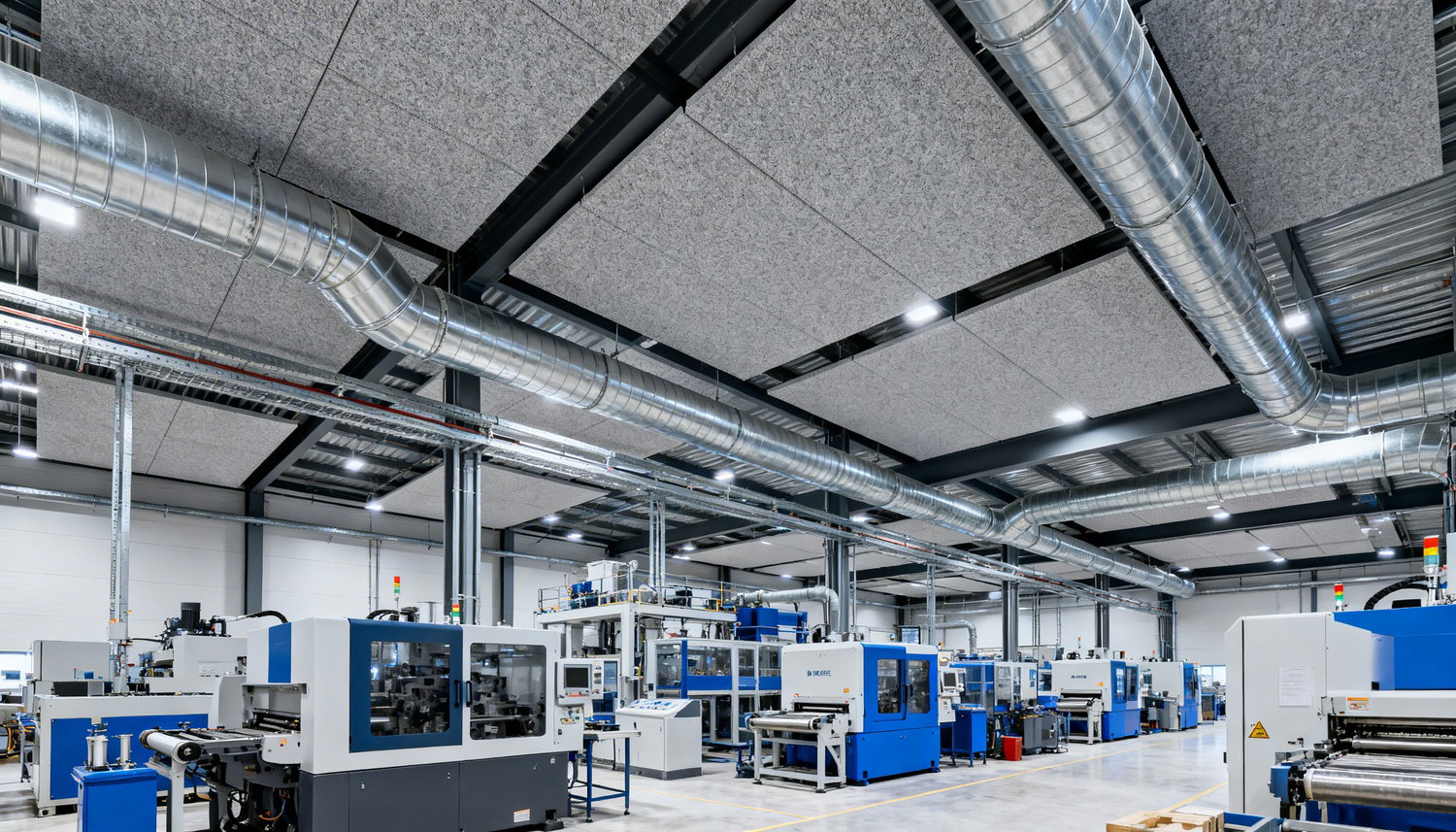
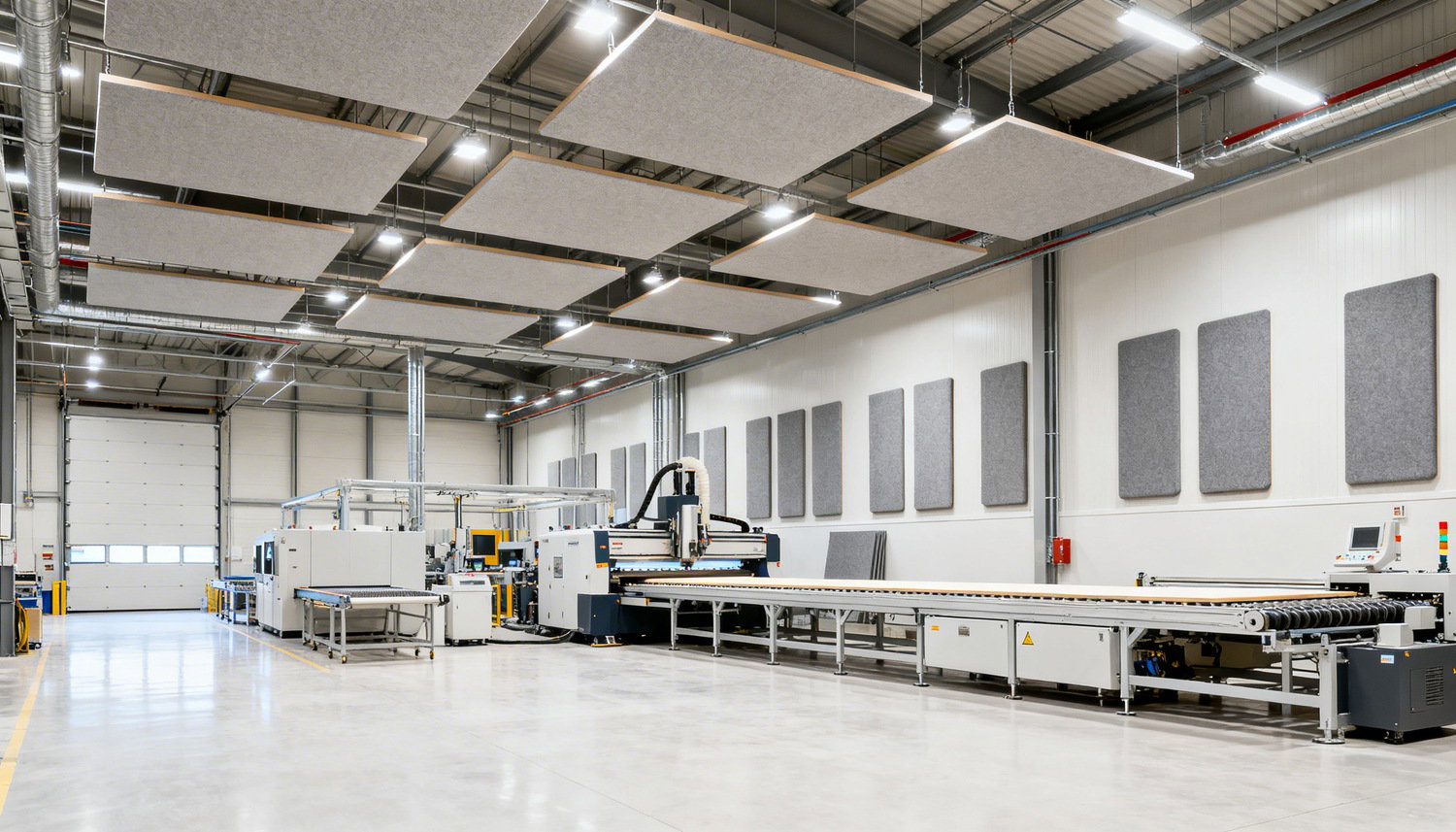
Even if the sound is prevented from leaving the room, it can still be perceived as unpleasantly loud inside the hall. This is often due to long reverberation times where sound waves bounce between walls, ceilings, and floors. Here, sound-absorbing measures are required to break the reflections of sound waves. SilentDirect PES Ceiling is an effective ceiling absorber that reduces reverberation in larger spaces. For walls, SilentDirect PES Wall or fabric-covered variants work well, both improving the acoustics and creating a pleasant work environment. For particularly exposed zones, SilentDirect Egg or SilentDirect Neo can also be used – especially near machines, corners, or tight spaces where sound is compressed. These products are installed where the noise levels are highest and where conventional sound absorption is insufficient.
Create partitioned zones with sound-dampening industrial curtains
In production halls with many different workstations, it can be difficult to treat the entire space at once. In that case, sound-dampening industrial curtains from SilentDirect are a convenient solution. These curtains create soundproof partitions between work areas, reducing noise transmission between different parts of the hall. The curtains can also be used to create temporary noise barriers during particularly noisy work moments or machine servicing.
Also consider sound leakage via doors and penetrations
Sound does not only travel through walls and ceilings – door gaps, cable penetrations, and ventilation ducts are also critical points. SilentDirect Seal is an effective sealing solution made of NBR rubber, used around door frames, service hatches, and penetrations to prevent sound from leaking through. By combining sealing strips with soundproof panels and absorption in the right zones, you can achieve a significantly better overall result.
Effective noise management for quieter production
By combining soundproofing and sound absorption, a noisy production hall can be transformed into a more pleasant and safe work environment. The right choice of materials – such as SilentDirect MLV for airborne sound, SilentDirect Neo and Polaric for vibrations and structure-borne noise, and SilentDirect PES products to reduce reverberation – makes it possible to reduce noise in an effective and sustainable way. Sound-dampening curtains, sealing strips, and targeted absorption at machines provide further improvements and adaptations to the space’s needs. A quieter production environment not only increases job satisfaction – it also reduces the risk of injuries and boosts overall productivity.