




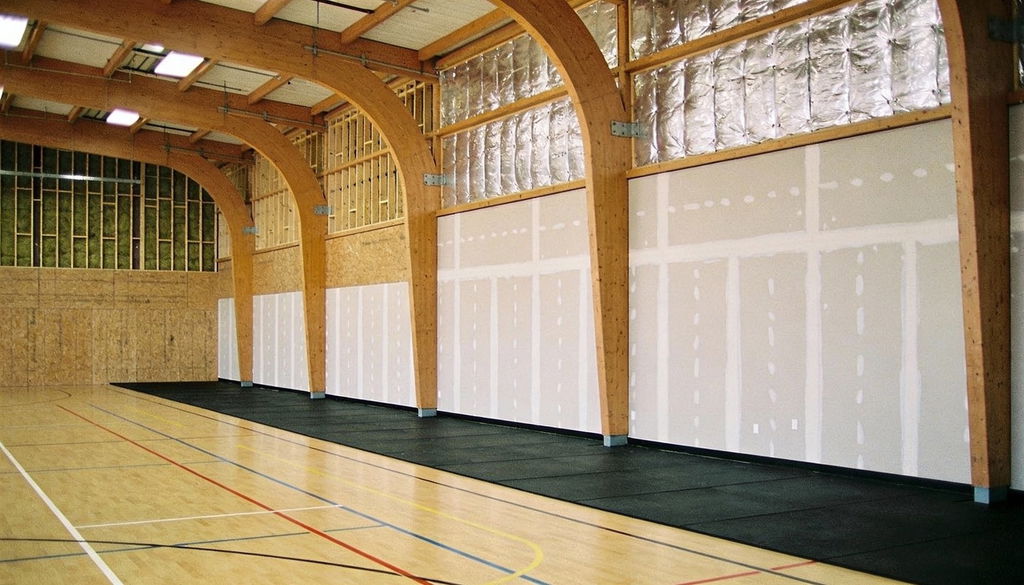
Soundproofing of sports halls – stops noise in schools and school environments
Limit sound propagation from sports activities to other school premises
In schools, the sports hall is often one of the most noise-intensive environments. Ball games, shouting, movement, impacts on the floor, and the use of equipment create high noise levels that easily spread to classrooms, corridors, and administrative areas. When noise from the sports hall travels through walls, floors, and ceilings, it has a negative impact on teaching, concentration, and the working environment. Soundproofing sports halls is therefore a crucial measure for stopping noise between rooms and creating effective separation in schools and school environments.
What does soundproofing a sports hall involve?
Soundproofing a sports hall means limiting how sound spreads from the hall to adjacent spaces through the building's construction. Unlike sound absorption, which is used to reduce echo and reverberation inside the hall itself, soundproofing focuses on stopping sound from traveling between different rooms. Vibration damping, in turn, is used to reduce structure-borne noise that occurs when movement and load are transferred to the building's frame. In school environments, a combination of these measures is often required, but sound insulation is the basis for limiting sound propagation.
Common noise problems from school sports halls
Noise from sports halls is often experienced as thumping ball sounds, shouting, echoing blows, and vibrations that spread to classrooms above or adjacent to the hall. The problems are exacerbated by large surfaces, hard materials, and vigorous physical activity. Because noise levels are high, even small weaknesses in the construction can lead to significant disturbances in other parts of the school.
How does sound spread from sports halls?
Sound spreads both as airborne sound and as structure-borne sound via the building's interconnected construction. Floors and joists can transmit impact sound to the floor above, while walls and ceilings can allow shouts and activity to pass through to adjacent spaces. Doors, gates, and technical penetrations often act as weak points where sound can easily pass through.
Airborne sound
Voices, whistles, and ball hits are transmitted through the air and can pass between rooms if the structure is not sufficiently insulated.
Structure-borne sound and vibrations
Movement and impacts on the floor create vibrations that propagate through the building's structure.
Relationship to sound absorption in sports halls
Sound insulation in sports halls should not be confused with sound absorption. Sound insulation stops sound between the sports hall and other parts of the school, while sound-absorbing solutions on walls, ceilings, curtains, or room dividers are used to reduce echo and reverberation inside the hall. To achieve both good separation and functional acoustics, these measures are often combined in school environments.
Why choose sound insulation for school sports halls?
Soundproofing a sports hall creates the conditions for parallel activities in the school without different activities disturbing each other. Teaching can continue undisturbed while sports lessons are being held, which improves both the study environment and the working environment. The measure also contributes to meeting requirements for the working environment and long-term functionality in school buildings.
Well-considered advice for the best results
For best results, the sports hall should be seen as an integral part of the school as a whole. A common mistake is to focus solely on the acoustics inside the hall without considering sound propagation to surrounding areas. By analyzing how sound and vibrations escape from the hall, the right insulation measures can be selected. The result is a more balanced and long-term functioning school environment.
Soundproofing sports halls is therefore a key measure for stopping noise in schools and school environments and creating better conditions for both teaching and sports.