






Soundproofing floors – stops sound between rooms in schools and school environments
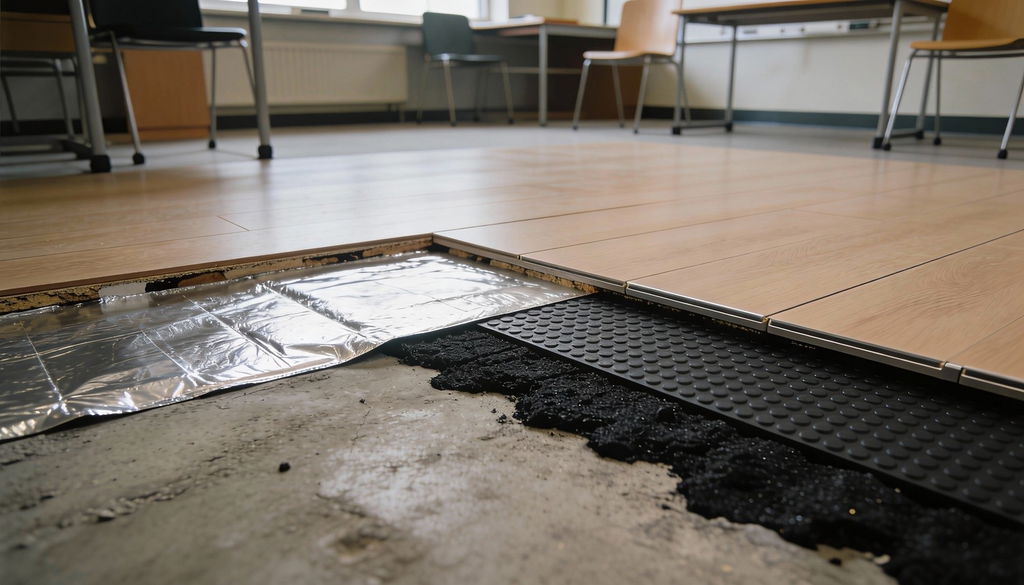
Reduce impact sound and structure-borne sound via the floor construction in school premises
In schools and educational environments, the floor is one of the most common routes for sound to spread between different spaces. Footsteps in corridors, movement between classrooms, chairs being dragged, play in common areas, and activity on floors above create vibrations that travel through the building's structure. These sounds can spread far from the source and disrupt teaching in adjacent classrooms or group rooms. Soundproofing floors is therefore an important measure to stop sound between rooms and create a better study environment in schools and educational environments.
What does soundproofing floors involve?
Soundproofing floors aims to reduce both airborne sound and structure-borne noise that occurs when the floor is loaded. Unlike sound absorption, which is used to reduce echo and reverberation in a room, sound insulation focuses on limiting the spread of sound between different spaces. Vibration damping, in turn, is used to reduce the movement itself from, for example, technical equipment or installations. In school environments, floor insulation is often a central part of an effective sound strategy.
Common problems with floor noise in school environments
In schools, floor noise is often perceived as footsteps from the floor above, running in corridors, scraping chairs, or movement in common areas. Cafeterias, gyms, and common areas can also generate noise that spreads to classrooms via the floor structure. This type of noise is often perceived as particularly disturbing because it propagates directly through the building's frame and is difficult to ignore during class.
How sound spreads through floors in school buildings
When the floor is loaded, vibrations are generated that are transmitted through joists, walls, and ceilings. Since school buildings often consist of interconnected structures, sound can spread between several rooms and floors. This means that the source of the sound is not always where the disturbance is perceived, making the floor a critical surface when it comes to problems with impact sound and structure-borne sound in schools and school environments.
Impact sound and movement
Noise from walking, running, and playing spreads effectively through the floor structure between classrooms and floors.
Furniture and daily use
Chairs, tables, and other school equipment that puts weight on the floor can create recurring sounds that spread throughout the building.
Relationship to sound absorption in school environments
Sound insulation of floors should not be confused with sound absorption. Floor insulation stops sound between different rooms, while sound-absorbing solutions on walls, ceilings, with sound-absorbing curtains or room dividers are used to reduce echo and reverberation within the same space. In school environments, these measures are often combined to both limit sound propagation and create pleasant acoustics in classrooms and common areas.
Why choose sound insulation for school floors?
Soundproofing floors contributes to a significantly improved study environment by reducing noise that would otherwise spread uncontrollably between classrooms. This measure creates better privacy, reduces distractions, and provides conditions conducive to concentration and learning. In many schools, floor insulation is a necessary foundation for other acoustic measures to be fully effective.
Well-considered advice for the best results
For best results, the floor should be seen as part of the school's overall acoustics. A common mistake is to focus only on the classroom's interior design, even though sound often spreads through the structure. By analyzing how sound and vibrations move between floors and spaces, the right insulation principles can be chosen. The result is a long-term, quieter, and more functional school environment.
Sound insulation of floors is therefore a key measure for stopping sound between rooms and creating a better study environment in schools and school environments.