











Floor vibration damping – reduces vibrations in schools and school environments
Reduce structure-borne noise and vibrations via the floor construction in schools
In schools and educational environments, the floor is a common route for vibrations that occur during daily activities. Movement in corridors, sports activities, technical equipment, cleaning machines, and installations can create mechanical vibrations that propagate through the floor construction and further into the building's structure. These vibrations can be perceived as disturbing structure-borne noise or vibrations in classrooms, group rooms, and staff rooms. Floor vibration damping aims to limit this transmission and create a calmer and more stable school environment.
What does floor vibration damping involve?
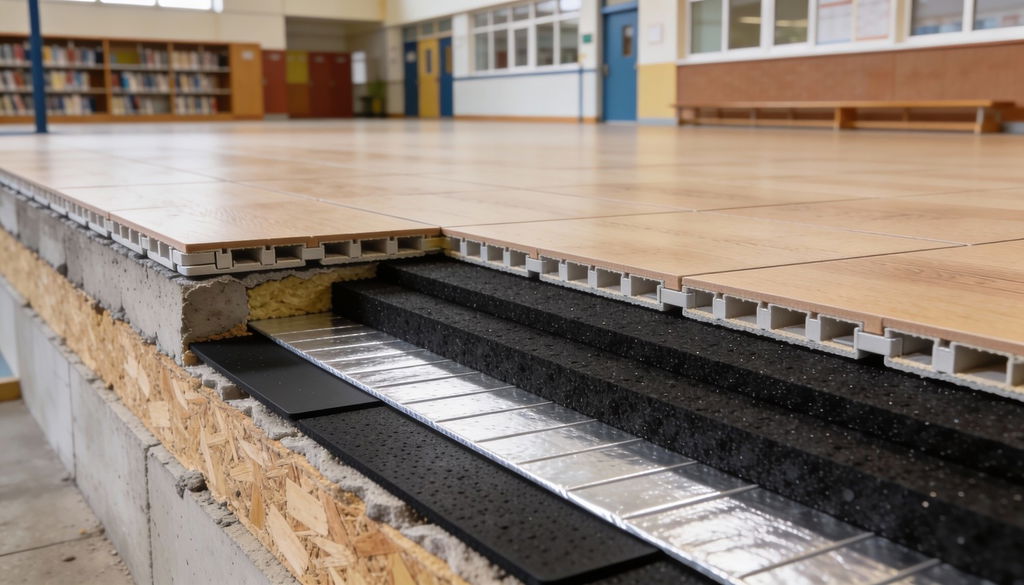
Floor vibration damping involves reducing how mechanical movements are transmitted from a source to the building's frame via the floor structure. Unlike sound insulation, which stops airborne sound between rooms, and sound absorption, which reduces echo and reverberation in the room, vibration damping focuses on reducing the vibrations in the structure itself. The measure is often directed at contact points where vibrations are transmitted, for example between equipment and the floor or between the floor and load-bearing elements.
Common problems with vibrations in school environments
In schools, vibrations in floors often arise from heavy foot traffic, running in corridors, physical education classes in adjacent rooms, and from technical equipment and installations. Cleaning machines, ventilation units, pumps, and other fixed or mobile equipment can create recurring vibrations that spread through the floor structure. The problems are often experienced as a dull hum, shaking, or low-frequency disturbances that affect study peace, concentration, and the working environment.
How do vibrations spread through the floor in schools?
When vibrations occur in the floor surface, the movement is transmitted to the floor structure and then up into the walls and ceiling. This means that the disturbance is not always experienced where the source is located, but in adjacent classrooms or floors. The floor thus acts as an effective spreading surface for vibrations in school buildings, especially in older structures or buildings with large contiguous floor structures.
Movement and activity
Running, playing, and heavy loads during the school day can create vibrations that propagate through the floor structure.
Equipment and installations
Machinery and technical installations placed directly on the floor can transmit vibrations to the entire building.
Relationship to sound absorption in schools
Vibration damping of floors should not be confused with sound absorption. While vibration damping reduces structure-borne noise and shaking in the structure, sound-absorbing solutions are used on walls, ceilings, with sound-absorbing curtains or room dividers to reduce echo and reverberation in the room. In school environments, these measures are often combined to both limit vibrations and improve the overall sound environment.
Why choose vibration damping for school floors?
Floor vibration damping contributes to a better study environment, increased concentration, and a more stable teaching environment. This measure is particularly important in schools with multiple floors, sports areas, or technical installations where vibrations would otherwise spread uncontrollably. In many cases, vibration damping is a necessary basic measure for other sound measures to work optimally.
Well-considered advice for the best results
For the best effect, both the source of the vibration and the floor construction should be analyzed. A common mistake is to try to remedy the disturbance where it is perceived, even though the cause is often located elsewhere. By breaking the vibration transmission early on, a more long-term calm, stable, and functional school environment is created.
Floor vibration damping is therefore a key measure for reducing disruptive vibrations and structure-borne noise in schools and school environments.