







Vibration damping of machinery and equipment in schools and school environments
Reduce structure-borne noise and vibrations from technical equipment in schools
In schools and educational environments, machines and technical equipment are a common source of disruptive vibrations. Ventilation units, fans, kitchen equipment, pumps, cleaning machines, and other technical equipment can create mechanical movements that propagate through floors, walls, and installations. These vibrations can cause structure-borne noise, low-frequency humming, or vibrations that are felt in classrooms, group rooms, and staff areas. Vibration damping of machines and equipment aims to break this mechanical transmission and create a quieter and more stable school environment.
What does vibration damping of machines involve?
Vibration damping means reducing how mechanical movements are transmitted from a machine to the building's structure. Unlike sound insulation, which stops airborne sound between rooms, and sound absorption, which reduces echo and reverberation in the room, vibration damping focuses on reducing the actual movement in the structure. When vibrations are limited at the source, the sound problems caused by resonance in the school building's structure are also reduced.
Common sources of vibration in school environments
In schools, vibrations often arise from ventilation systems, fans, heat pumps, and technical installations that are in operation for much of the school day. Kitchen equipment in school cafeterias, dishwashers, refrigerators, and cleaning machines can also create recurring vibrations that spread throughout the building.
Technical rooms and substations are particularly vulnerable, as the equipment is often located close to classrooms. Vibrations from fans and pumps can travel through floors and walls and be perceived as a dull hum in classrooms or workrooms.
Even smaller equipment such as copiers, printers, and freestanding ventilation units can cause disturbances if they are placed directly on the floor or mounted without vibration-damping measures.
How do vibrations spread in school buildings?
When a machine vibrates, the movement is transferred mechanically to the surface and further through the building's frame. Floors, walls, pipes, and installations act as conducting structures where vibrations can spread and be amplified. This means that the problems are often experienced in places other than where the equipment is located, which is common in school buildings with interconnected structures.
Principles for effective vibration damping in schools
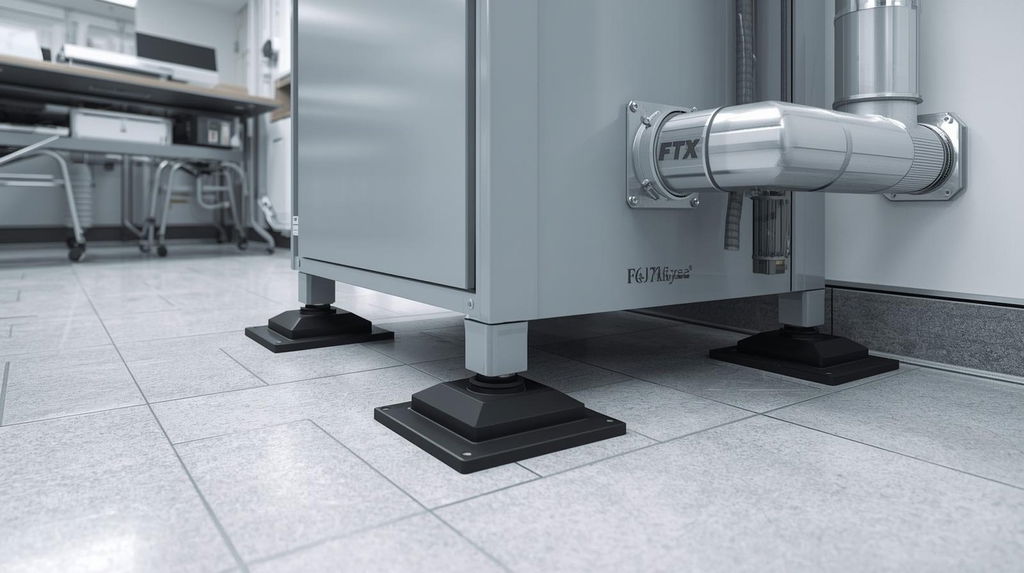
Effective vibration damping is based on reducing direct contact between the machine and the building frame. Through mechanical decoupling, elastic spacers, and proper fastening, vibrations can be slowed down before they spread further. The goal is to manage the vibrations at the source rather than trying to dampen the effects in classrooms and teaching environments after the fact.
Well-thought-out advice for best results
For best results, each machine should be analyzed based on its location, operating time, and how vibrations spread throughout the school building. A common mistake is to try to remedy the disturbance where it is experienced, even though the source is often located in a technical or service area. By working systematically with vibration damping directly at the equipment, a more long-term calm, stable, and functional school environment is created.
Vibration damping of machines and equipment is therefore a key measure for reducing structure-borne noise, improving study conditions, and creating better working conditions in schools and school environments.