






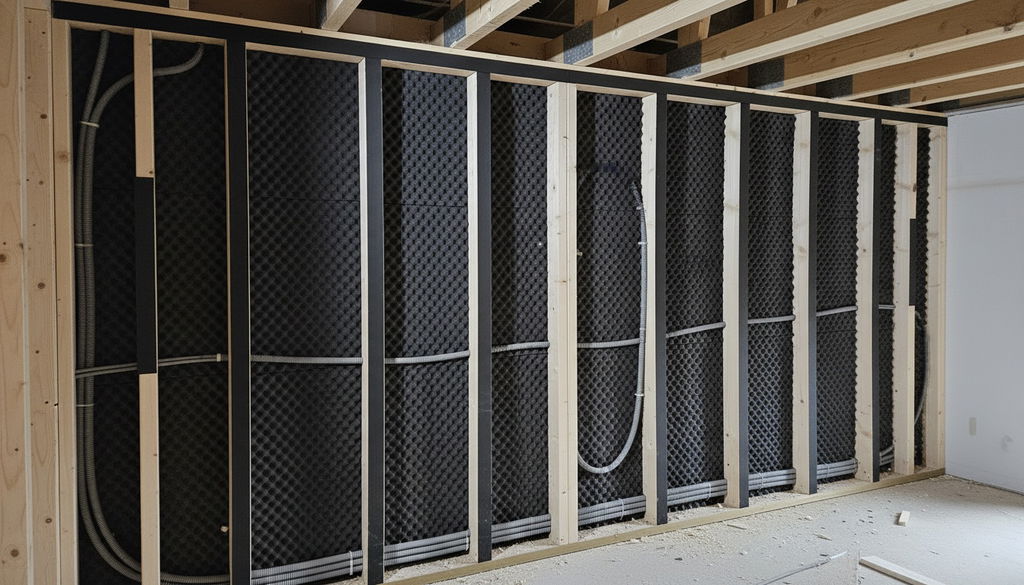
Vibration damping of walls and ceilings in schools and school environments
Reduce structure-borne noise and vibrations transmitted through walls and ceilings in schools
In schools and educational environments, vibrations from technical equipment, installations, and building systems can spread through walls and ceilings. When vibrations are transmitted through the building's structure, structure-borne noise, low-frequency humming, or recurring vibrations often occur, which negatively affect both teaching and the working environment. These disturbances can be felt in several classrooms or common areas at the same time and are often difficult to locate. Vibration damping of walls and ceilings aims to limit this transmission and reduce how vibrations spread in the school building's structure.
What does vibration damping of walls and ceilings involve?
Vibration damping of walls and ceilings means reducing how mechanical movements are transmitted through the building's load-bearing parts. Unlike sound insulation, which stops airborne sound between rooms, and sound absorption, which reduces echo and reverberation in the room, vibration damping focuses on reducing the vibrations themselves in the structure. The goal is to break the mechanical connection that causes movements to spread through studs, fastenings, and connected building parts in the school environment.
Common problems with vibrations through walls and ceilings in schools
In school environments, vibration problems often arise when technical equipment is mounted on walls or ceilings, such as ventilation units, fans, cooling systems, or piping. Vibrations from machines placed on the floor can also spread upward through walls and ceilings and be perceived as disturbing noise in classrooms, group rooms, libraries, or staff rooms. The problems often manifest themselves as a dull humming, pulsating sound, or subtle shaking that affects concentration, study peace, and work peace.
How do vibrations spread in wall and ceiling structures?
When vibrations are introduced into a wall or ceiling, the movement continues through studs, board material, fastenings, and connections to other building components. The structure can act as a conducting structure where the vibrations are spread further and sometimes amplified by resonance. This means that the disturbances are often experienced far from the actual source of the vibrations, which is common in school buildings with large, contiguous structures.
Vibrations via fastenings
Fixed installations can transfer mechanical movements directly to walls and ceilings in classrooms and common areas.
Spread between building components
Walls and ceilings often act as links that transmit vibrations between different parts of the school building.
Why choose vibration damping for walls and ceilings in schools?
Vibration damping of walls and ceilings is often crucial when disturbances cannot be resolved by measures taken on machines or in the floor construction alone. By reducing the spread of vibrations in these building components, both structure-borne noise and perceived shaking can be effectively reduced. This measure contributes to a calmer, more stable school environment where study peace, teaching quality, and the working environment are improved.
Well-considered advice for best results
For the best effect, it is important to identify how the vibrations enter the wall and ceiling structure. A common mistake is to focus solely on the sound that is heard, without taking into account the mechanical transmission in the building. By working with vibration damping where the movement is led into the structure, the disturbances can be reduced more effectively and in the long term.
Vibration damping of walls and ceilings is therefore an important measure for reducing disturbing vibrations and structure-borne noise in schools and school environments.