







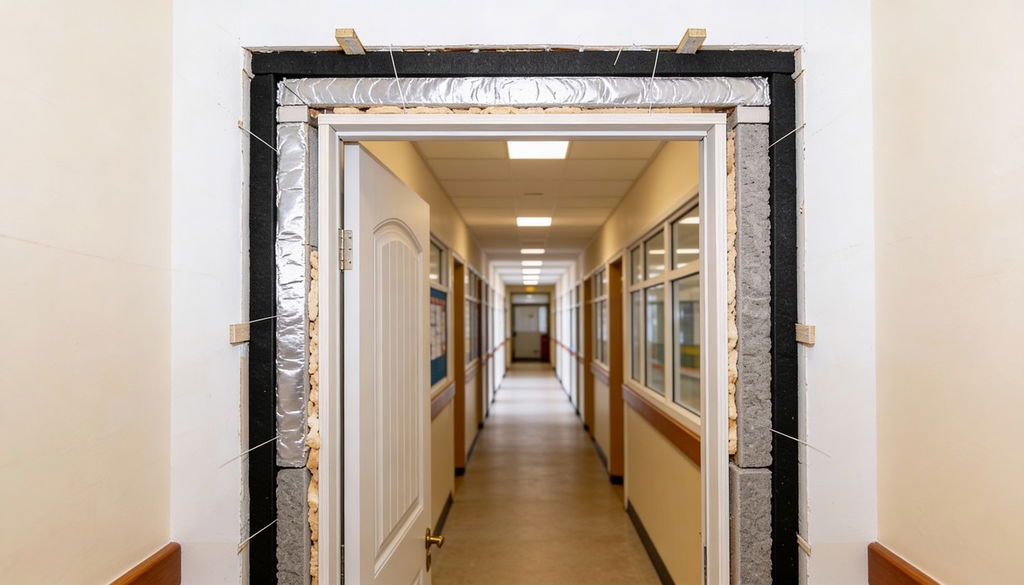
Soundproofing doors and windows – stops noise in schools and school environments
Reduce sound leakage between classrooms, corridors, and common areas
In schools and educational environments, doors and windows are often the most critical points when it comes to sound insulation. Even if walls, floors, and ceilings are adapted to the school's needs, sound can easily pass through door leaves, frames, glass sections, and small gaps. Voices from classrooms, noise from corridors, canteens, or sports halls, and noise from adjacent spaces can thus spread and disrupt teaching. Soundproofing doors and windows is therefore a key measure for stopping sound propagation and creating a better learning environment in schools and educational environments.
Why do doors and windows let sound through?
Doors and windows are movable building components that often have lower mass and poorer sealing than other structures. Sound can pass through both the material and through gaps around frames, thresholds, and fittings. In school environments, the problem is exacerbated by high frequency of use, wear and tear, and varying noise levels during the school day, which means that even minor leaks have a major impact on the sound environment.
Common noise problems in school environments
Typical problems include sound leaking between classrooms, teaching noise disturbing group rooms, or corridor noise affecting ongoing lessons. Noise from dining halls, common areas, and gyms can also spread to classrooms if doors and windows are not sufficiently soundproofed. The result is impaired concentration, poorer speech perception, and a more stressful working environment for both students and staff.
How does sound insulation of doors and windows work?
Soundproofing doors and windows is based on limiting the passage of sound through increased density, better construction, and reduced air leakage. The measure focuses on stopping airborne sound between rooms, not on affecting the room's acoustics or reverberation.
Sealing gaps and connections
Gaps around frames, thresholds, and glass sections are often the main cause of sound leakage in schools.
Enhanced insulating function
Doors and windows with low sound insulation can be improved through targeted measures that increase their resistance to sound transmission.
The difference between sound insulation, sound absorption, and vibration damping
Sound insulation stops sound between different spaces, such as between classrooms and corridors. Sound absorption is used to reduce echo and reverberation in the room through solutions on walls, ceilings, sound-absorbing curtains, or room dividers. Vibration damping reduces structure-borne noise from technical equipment and installations. In school environments, these measures are often combined to achieve a functional overall solution.
Why prioritise doors and windows in schools?
Doors and windows are often the limiting factor for the sound insulation of an entire room. By addressing these surfaces, sound propagation can be significantly reduced, creating a clearer distinction between teaching, breaks, and communal activities. This directly contributes to a better study environment and a more sustainable working environment.
Well-thought-out advice for the best results
For the best effect, doors and windows should always be seen as part of the school's overall sound environment. A common mistake is to focus on walls and ceilings but overlook moving parts of the building. By identifying where sound leakage occurs and addressing these points, long-term effective sound insulation tailored to schools and the school environment can be created.
Soundproofing doors and windows is therefore a crucial measure for stopping noise and creating a better atmosphere of calm, focus, and quiet study in school premises.