Step-by-step: How to effectively soundproof a production hall
A production hall should be soundproofed in the correct order. Start by identifying where the noise originates and how it spreads. Next, seal any leaks, isolate noisy sources, reinforce structures with sound-damping material, and dampen vibrations at contact points. Only once sound transmission has been addressed can sound absorption be used as a final complement to improve the acoustics inside the hall.
Step 1: Map sound sources and sound paths
Start by identifying which machines, work processes, ventilation components, gates, doors, and adjacent rooms are most affected. Walk through the production hall while it is in operation and note whether the sound comes primarily from individual machines, large open areas, floor vibrations, or leaks into offices and staff areas.
Step 1.1
Check doors, windows, gates, gaps, penetrations, and connections. If the noise is clearly audible on the other side of a door or wall, it is often a combination of insufficient mass and leaks that needs to be addressed.
Step 1.2
Check whether machines are in direct contact with the floor or on stands. If vibrations are felt in the floor, walls, or nearby structures, sound insulation must be supplemented with vibration damping to reduce structure-borne noise and sound bridges.
Results
You’ll get a clear picture of whether the problem is primarily due to airborne sound, leaks, vibrations, or a combination of multiple sound paths.
Step 2: Seal the weak points first
Before installing heavy materials or barriers, obvious sound leaks should be sealed. Use Sealing Strip for Windows & Doors - SilentDirect Seal 20 meters around doors, windows, and connections where airborne sound can pass. The product is used where sealing is important to reduce sound leakage between the production hall and adjacent spaces.
Step 2.1
Install the sealing strip on clean, dry, and smooth surfaces. Check that doors and hatches can still close properly, as the seal must fit snugly without creating new gaps.
Step 2.2
For doors where sound leaks at the floor , the SilentDirect seal door bottom strip can be used to reduce sound transmission under the door leaf. This is particularly relevant between production halls, offices, break rooms, and storage areas.
Results
By sealing leaks, you address the most common weak points before implementing more extensive soundproofing measures.
Step 3: Build a sound barrier or enclosure around noisy machines
If a machine dominates the noise level, the measure should be placed as close to the source as possible. Create a soundproofing screen, hood, or enclosure where technically feasible. Use Soundproofing - SilentDirect MLV where the goal is to add mass and block airborne sound.
Step 3.1
Place the MLV in the screen or wall construction so that it functions as a continuous sound barrier layer. Avoid gaps at the joints and ensure that the material connects tightly to surrounding surfaces.
Step 3.2
On sheet metal, machine housings, or surfaces that require both sound insulation and vibration damping, the Sound Insulation Damping Mat - SilentDirect Polaric can be used. It is suitable when sound is affected by airborne sound, vibrations, and resonance in hard surfaces.
Results
Sound is contained closer to the source, reducing its spread to other parts of the production hall and to adjacent premises.
Step 4: Reduce vibrations at contact points
If machines, compressors, pumps, or other equipment generate vibrations, the contact transmission must be broken. Use the Dampio PRO 100x100x23 mm vibration dampener – high load 750 kg – under suitable machine feet or equipment points when the load and installation allow it.
Step 4.1
Place the vibration dampers where the machine transfers force to the floor or stand. Always check the machine’s weight, stability, and operating requirements before installation.
Step 4.2
For smaller structures, sheet materials, machine enclosures, or contact surfaces, Sound Insulation - SilentDirect Neo can be used where the goal is to reduce vibrations, resonances, and mechanical noise. For larger surfaces, Sound Absorber and Sound Insulation - SilentDirect Neo roll may be more practical.
Results
Structure-borne noise and sound bridges are reduced when vibrations are no longer transmitted as easily from the machine to the building’s structures.
Step 5: Reinforce walls, screens, and exposed surfaces
If sound spreads through walls or partition structures toward offices, control rooms, or staff areas, the surface needs to be reinforced. Use Sound Insulation - SilentDirect MLV as a sound barrier when airborne sound needs to be blocked, and combine it with sealed connections to prevent leakage.
Step 5.1
Ensure that joints, transitions, and connections do not become sound bridges. Where the structure abuts an existing building component , Window & Door Sealing Strip - SilentDirect Seal 20 meters can be used as a supplementary measure to reduce contact paths and improve sealing.
Step 5.2
For surfaces near machinery, enclosures, or smaller screens, Sound Insulation - SilentDirect Egg or Sound Absorber and Sound Insulation - SilentDirect Egg Roll can be used where the structure requires additional sound insulation and damping in industrial environments.
Results
Walls, screens, and machine-adjacent structures gain a better ability to prevent sound from passing on to other surfaces and spaces.
Step 6: Screen off work zones when the entire hall cannot be remodeled
In large production halls, it is not always possible to remodel the entire facility. In such cases, local noise barriers can be a practical part of the sound insulation. Sound-absorbing noise barrier - SilentDirect Sound Barrier 2.48m is suitable when you want to block noise and reduce sound propagation in demanding environments.
Step 6.1
Place the noise barrier between the noise source and the work area that needs protection. For best results, the barrier should be placed close to the noise source or close to the recipient and supplemented with sealing where sound might otherwise pass around the structure.
Step 6.2
Ensure that the screen does not obstruct forklift paths, service access, ventilation, or safety procedures. In production environments, soundproofing solutions must always work in harmony with practical operations.
Results
Local work zones can be protected without having to rebuild the entire production hall, while at the same time making sound propagation more controlled.
Step 7: Add sound absorption only after sound insulation has been addressed
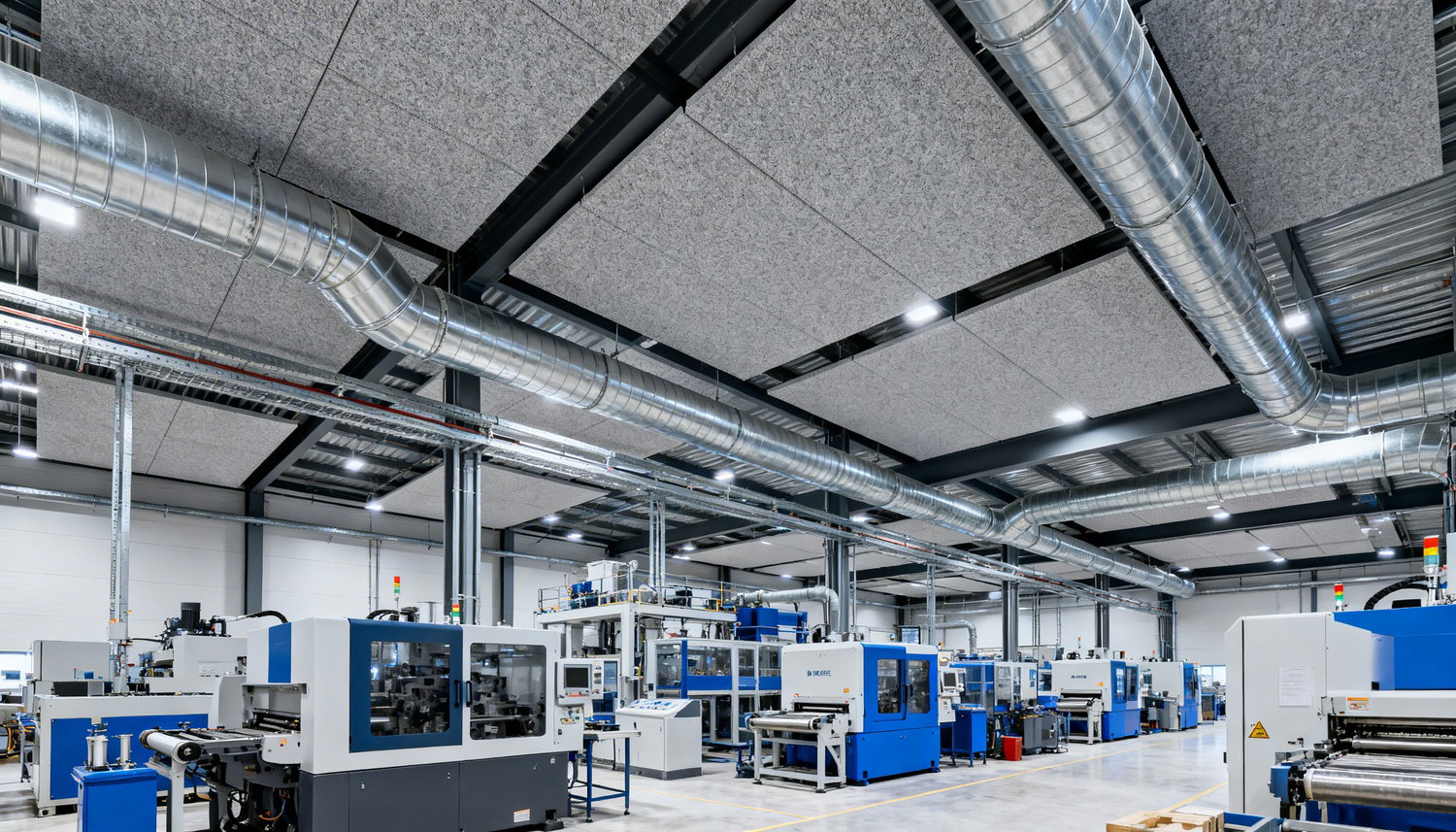
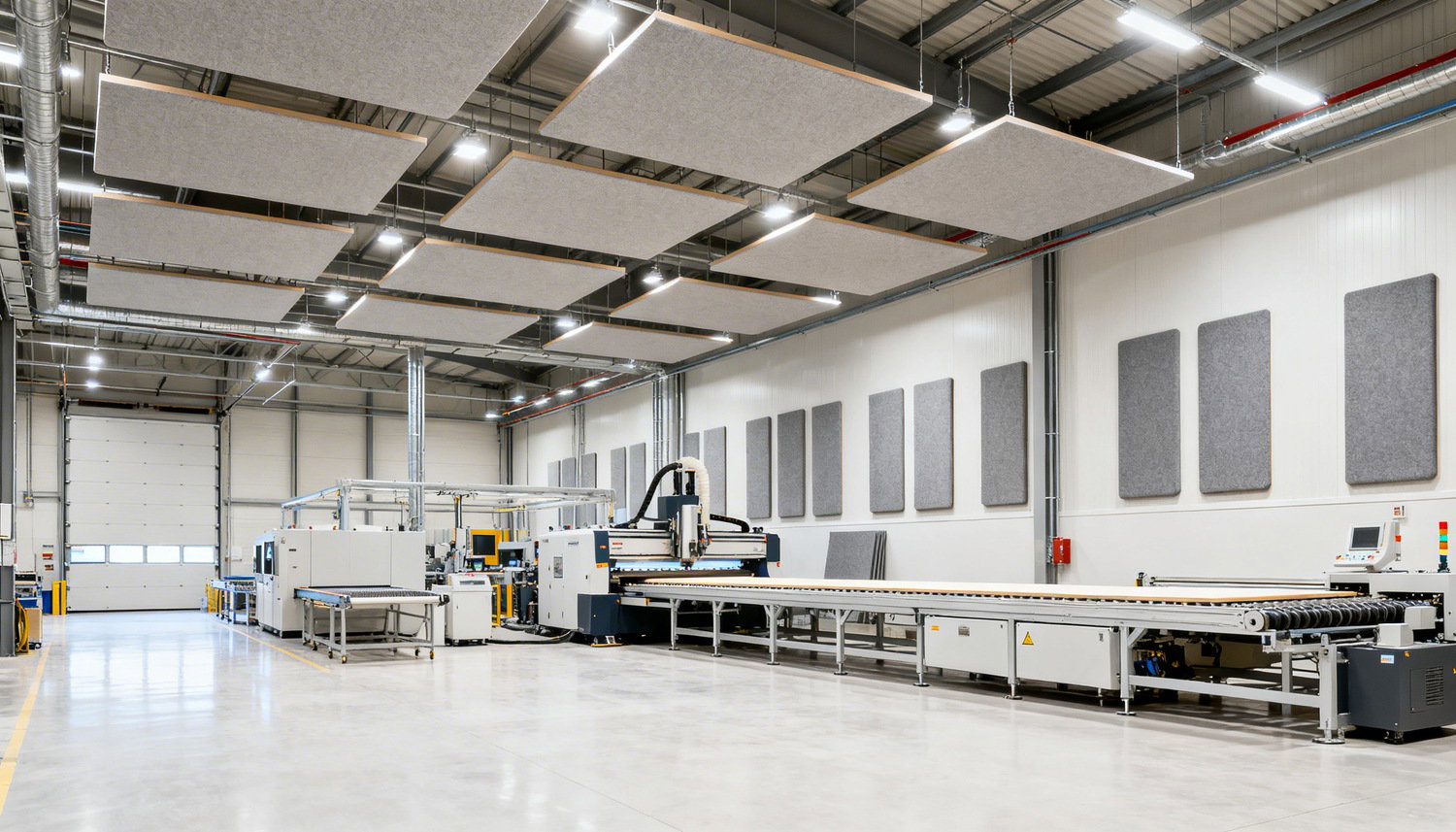
Once sound leakage, machine enclosures, walls, doors, and vibrations have been addressed, the hall may still have harsh acoustics. In that case, sound absorption can be used as a final step to reduce reverberation inside the space. It is important to view this as a complement, not a replacement for sound insulation.
Step 7.1
Prioritize ceiling and wall surfaces where sound reflections are strong, especially in open halls with concrete floors, metal surfaces, and high ceilings. This measure improves communication inside the hall but does not prevent sound from escaping the room on its own.
Result
The production hall achieves a more controlled acoustic environment where both sound transmission and internal harsh acoustics are addressed in the correct order.