


















• Free shipping
  • 5-year warranty
  • Fast delivery

Soundproofing call centers and open-plan offices – Create a quieter and more focused work environment

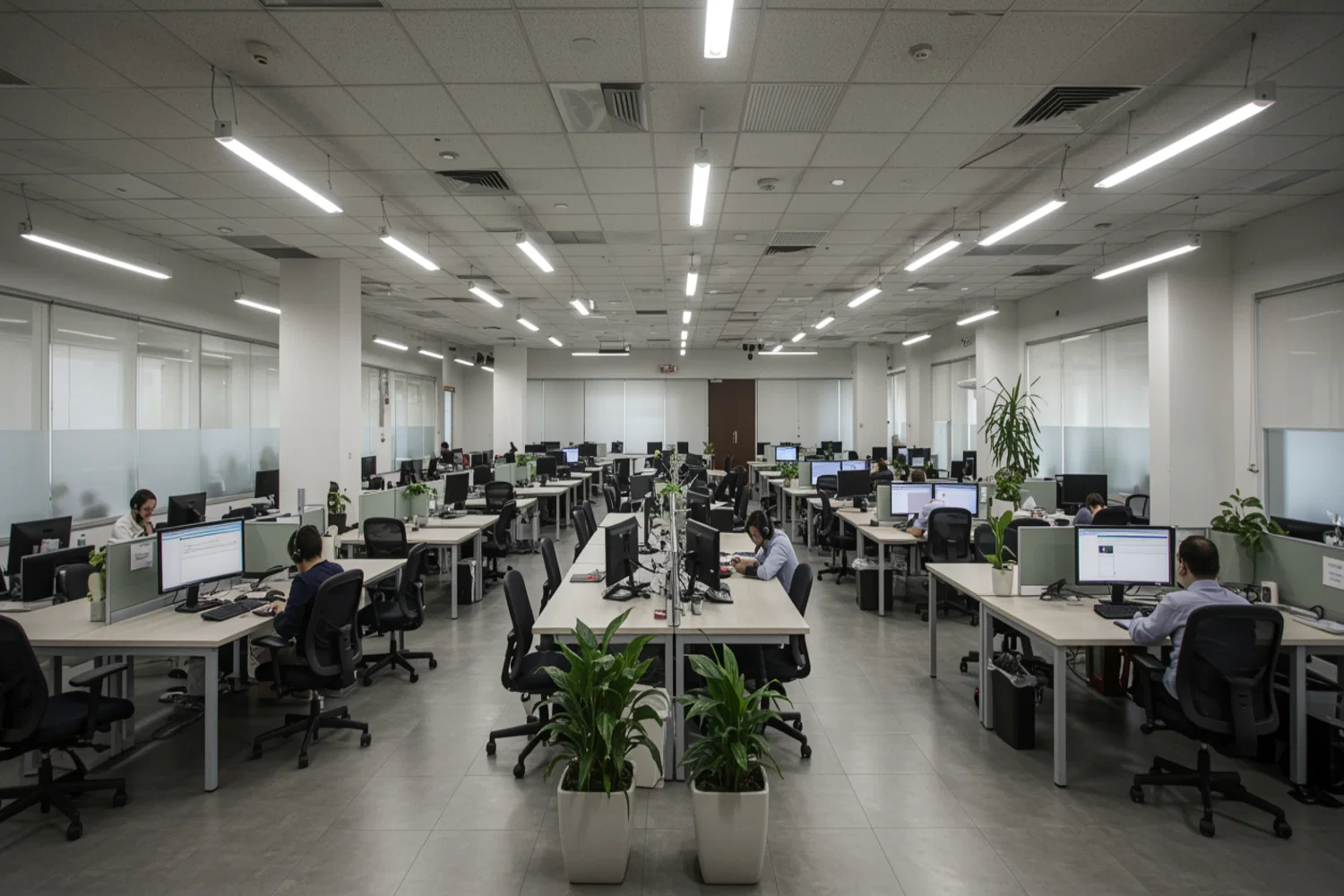
Call centers and open-plan offices are among the most acoustically challenging work environments.
Concurrent conversations, ringtones, keyboard clicks, and movement in the room quickly create a high noise level that affects concentration, peace of mind, and well-being.
When sound bounces off hard surfaces, the noise is further amplified, making even normal conversations feel stressful and intrusive.

A poor acoustic environment in open-plan offices often leads to reduced focus, increased mental fatigue, and more communication misunderstandings.
In call centers, the problem becomes particularly evident—employees need to speak louder to be heard, which in turn raises the noise level throughout the entire space.
The result is a vicious cycle where productivity and work quality decline.

By taking a structured approach to sound absorption, it is possible to break this noise spiral.
With the proper placement of sound absorbers on ceilings, walls, and between workstations, reverberation and sound propagation can be effectively reduced.
This makes conversations clearer, reduces background noise, and creates a more pleasant and professional work environment.

In this guide, we’ll walk you through how to soundproof call centers and open-plan offices in a smart and sustainable way.
You’ll get practical advice on placement, solutions for different types of surfaces, and how to create zones for better focus and lower stress levels.
A sound-absorbing work environment is one that supports both performance and well-being.

Recommended products

Benefits of soundproofing a call center or open-plan office

Reduced noise levels
Inside call centers and open-plan offices, there is often a constant background noise from conversations, keyboards, and movement.
Using sound absorbers reduces reverberation and the perceived noise level, creating a calmer and more controlled acoustic environment.

Better call quality
When reverberation and echoes are dampened, voices become clearer.
This is crucial in call centers where clear communication is essential for effective customer interactions and fewer misunderstandings.

Increased concentration and productivity
Less noise makes it easier to focus on work tasks.
Employees can work more efficiently without being constantly interrupted by colleagues’ conversations or sounds bouncing off hard surfaces.

Reduced stress and fatigue
High noise levels over extended periods can contribute to mental fatigue and stress.
A sound-absorbing work environment makes for a more pleasant workday and can reduce the risk of headaches and noise-related stress.

Improved work environment and well-being
Balanced acoustics make the workplace feel more professional and well-thought-out.
This increases job satisfaction and can contribute to higher employee engagement.

Increased privacy during conversations
By absorbing sound, sound propagation between workstations is reduced.
This provides better privacy during conversations and is particularly important in environments where sensitive information is handled.

Flexible and aesthetic solution
Sound-absorbing products come in many shapes and designs—from ceiling absorbers and wall panels to room dividers and curtains.
This makes it possible to improve acoustics without compromising the office design.

Long-term and cost-effective investment
By addressing the acoustics, the need for temporary solutions and future adjustments is reduced.
A good acoustic environment is a sustainable investment that benefits both employers and employees over time.

Selected articles on "Guides for measurements in call centers"

Guide to Choosing the Right Sound Insulation for Different Frequencies

Different frequencies behave differently. This means that no single solution works for all types of sound problems.

What methods are used to measure sound?

There are several methods for measuring sound, and the choice of method depends on which aspect of the sound you want to evaluate.

How we perceive a decrease in decibels

How is a reduction in decibels perceived? Here, we explain in simple terms how different levels of decibel reduction are perceived.

Echo - How to reduce echo in a room

Reducing reverberation in a room means reducing sound reflections and preventing sound waves from bouncing around the room.

Step-by-step: How to soundproof a call center or open-plan office – boost productivity

In open-plan areas, noise is almost constant. Conversations take place simultaneously, sound travels freely between workstations, and hard surfaces cause voices to “bounce” and amplify.
To achieve a noticeable improvement, a single measure is rarely enough—you need to work step by step and address both ceilings, walls, and surfaces that contribute to sound propagation.
Here is a comprehensive guide showing how to create a quieter and more professional acoustic environment.

Step 1: Map the noise and identify the most disruptive zones

Start by listening to the space during normal operation. Walk around the room and note where the sound feels most intrusive.

– Is there a “buzz” of many voices building up in the center of the room?
– Are certain teams heard extra clearly throughout the room?
– Are there surfaces where the sound becomes sharp, echoing, or piercing?
– Is the sound problem worst near walls, glass partitions, or in corners?

Once you’ve identified the most affected zones, it becomes easier to implement solutions where they’ll have the greatest impact.

Step 2: Start with the ceiling – the quickest way to reduce reverberation

In open-plan offices, the ceiling is often the largest free reflection surface. When you absorb sound at the ceiling, reverberation time decreases and the overall sound level drops throughout the space.

– Prioritize surfaces above workstations where most conversations take place
– In larger spaces, an evenly distributed “ceiling array” often provides better results than small, isolated installations
– The more hard surfaces there are (glass, concrete, drywall), the more important ceiling absorption becomes

This step usually provides the most noticeable overall improvement and makes the room feel calmer immediately.

Step 3: Dampen walls and early reflections for a clearer sound environment

Although the ceiling is most important, walls can account for a significant portion of disruptive reflected sound—especially in open-plan offices where sound travels far.
By installing wall absorbers on strategic surfaces, you can reduce reflections that otherwise amplify “background noise.”

– Focus on large, contiguous wall surfaces where sound bounces a lot
– Prioritize areas near meeting tables, collaboration zones, and hallways
– If you have a lot of glass, you’ll need extra absorption on nearby walls

The result is a less “harsh” soundscape, better speech intelligibility, and a room that feels more balanced.

Step 4: Create sound zones between workstations for a quieter work environment

In call centers and open-plan offices, the problem is often not just reverberation, but sound traveling directly between people.
Here, zoning is one of the most effective methods.

– Use sound-absorbing room dividers to break the line of sight between teams
– Create quieter areas for focused work and separate zones for conversations
– In call centers, partitions between workstations allow more people to speak at a normal volume

When sound propagation decreases, the noise level often drops automatically, as staff do not need to raise their voices.

Step 5: Dampen hard surfaces and glass with textile solutions

Large windows, glass walls, and smooth surfaces act as “acoustic mirrors” and can make sound feel harsher than it actually is.
Textile, sound-absorbing solutions help soften the room and reduce reflections.

– Sound-absorbing curtains are particularly effective around glass and large shiny surfaces
– In open-plan offices, curtains can also serve as flexible room dividers

The result is a softer and more pleasant acoustic character

Step 6: Reduce disruptive background noise—chairs, scraping, and contact sounds

In many offices, irritating sounds come not only from voices, but from chairs scraping, furniture being moved, and small vibrations against the floor.
These sounds create “sound peaks” that raise perceived stress levels.

– Add cushioning to chair legs to reduce scraping noises in meeting areas and at desks
– Review furniture that is frequently moved and create softer contact points

Small measures here can make the work environment noticeably calmer in everyday life

Step 7: Add smart wall features that also absorb sound

If you want to combine functionality and acoustics, sound-absorbing bulletin boards are an effective solution.
They can be placed where you want communication surfaces anyway, while also contributing to better acoustics.

– Place them in areas with a lot of reflections or where many people pass by

A good choice for team areas, project zones, and meeting spaces

Step 8: Test the effect and fine-tune where sound still “leaks”

Once the measures are in place, it’s important to evaluate them. Listen during a normal workday and compare with Step 1.

– Has the noise level decreased throughout the entire space?
– Are certain zones still too noisy?
– Is more screening needed between teams?
– Are there walls or glass surfaces that still reflect sound heavily?

Often, making local adjustments—such as adding more sound absorption to a problematic wall or installing an extra room divider—is enough to achieve that final, noticeable improvement.

Create a work environment where sound doesn’t take over

When you soundproof call centers and open-plan offices step by step, you’re not just lowering the noise level—you’re improving the entire work environment.
With shorter reverberation times, less sound diffusion, and clearer zones, conversations become more controlled, focus comes more easily, and stress levels drop.
The result is a workplace that feels calmer, more professional, and significantly more pleasant to work in every day.

Selected articles on "Sound absorption in open-plan offices"

Soundproof a room.

Where should you start with sound absorption?
Does using fabric work for sound absorption?
Here you’ll find the answer to how best to soundproof and dampen a room.

Soundproof an office.

Soundproofing an office is a key factor in creating a work environment that promotes concentration, productivity, and well-being.

Soundproof a conference room.

With the right sound-absorbing solutions in conference rooms, you can create clearer communication and a professional, quiet environment.

Sound absorbers for large glass surfaces.

Rooms with large glass surfaces often present acoustic challenges, as glass reflects sound and can prolong reverberation.

Products best suited for sound absorption in your call centers and open-plan offices

To create an effective acoustic environment in these open-plan offices, products are needed that reduce reverberation, dampen sound reflections, and create acoustic zones.
Below are recommended solutions that work in practice—for both large spaces and workstations.

SilentDirect PES/PES Fabric for suspended ceilings – acoustic absorber for suspended ceilings
SilentDirect PES for suspended ceilings is a sound-absorbing panel installed in suspended ceilings to effectively reduce reverberation time in large spaces.
The absorber is available in both the original version and with a fabric-covered surface layer, providing both acoustic performance and an aesthetically pleasing appearance that works well in open-plan offices.

SilentDirect PES – sound absorber for ceilings and walls
SilentDirect PES/PES Fabric are lightweight and effective sound absorbers installed on ceilings or walls to capture reflected sound.
These products prevent voices and conversations from bouncing around the room, creating a more comfortable acoustic environment and improved speech intelligibility.

Silent Socks Original – sound dampening for chairs and furniture
Silent Socks Original dampen noise from chairs scraping and being moved, which often contributes to noise in open-plan offices.
By attaching these directly to the chair legs, scraping sounds, vibrations, and disruptive peaks in sound levels can be significantly reduced.

SilentDirect Bulletin – sound-absorbing bulletin board
SilentDirect Bulletin combines functionality with sound absorption.
It serves both as a bulletin board and as an acoustic surface, making it perfect for walls in areas where information is stored and communicated.
The product helps reduce reflections from wall surfaces without creating a “closed-off” impression.

Silent Divider Felt – flexible sound-absorbing room divider
Silent Divider Felt is a textile-based room divider that absorbs sound while creating natural work zones in open office spaces.
It is used to break up open floor plans, which reduces sound propagation and provides greater comfort at workstations and meeting areas.

Silent Curtain Felt – sound-absorbing curtain for open spaces
Silent Curtain Felt is a sound-absorbing curtain that helps reduce reflections from large glass surfaces, walls, and open areas.
The curtain creates a softer sound environment and is often used as a complementary solution when traditional absorbers are insufficient or where flexibility is needed.

By combining these products, you create a work environment where the perceived noise level is lower, communication is clearer, and the space is more comfortable.

Selected articles on "Soundproofing call centers and open-plan offices"

Use plants to reduce noise.

Plants can scatter (break up) and partially absorb sound waves through their leaves, stems, and other parts. The larger the plant, the better.

Sound-absorbing bulletin board.

Sound-absorbing bulletin boards are specially designed bulletin boards that serve both as bulletin boards and as sound absorbers.

Zoning with room dividers.

Room dividers are an effective solution for reducing disruptive noise, improving acoustic comfort, and optimizing space as needed.

Sound-absorbing panels.

Sound-absorbing panels are an aesthetically pleasing solution for improving acoustics, combining both sound absorption and visual appeal.

Did you know that…

Why might two people talking at the same time in an open-plan office seem significantly more disruptive than ten people in a well-soundproofed room?
This is because reverberation and sound reflections make it harder for the brain to filter out background noise—not because of how loud it actually is.

Most often, the biggest culprit isn’t the sound level itself, but the reverberation time.
When voices bounce off ceilings, walls, and glass surfaces, each word is prolonged, causing conversations to blend into a constant, stressful noise even at moderate decibel levels.

Studies show that properly placed sound absorption can reduce the perceived noise level by up to 30%, without a single person speaking more quietly.
This means the work environment becomes calmer, more focused, and less mentally taxing—simply by controlling how sound behaves in the room.

So the next time an office feels unnecessarily noisy, even though no one is actually making much noise, it’s often the acoustics that are the problem—not the people in the room.

Selected articles on "Reducing noise in call centers and open-plan offices"

How many sound absorbers do I need to install?

With our reverberation time calculator, you can easily determine how many sound absorbers you should install to create an acoustically pleasant environment.

Where should sound absorbers be placed?

Proper placement determines how effectively the absorbers dampen sound. Whether you want to improve the acoustic environment in an office, conference room, or home studio.

Sound-absorbing fabric room dividers.

Fabric sound-absorbing room dividers are a practical solution for reducing noise, minimizing reverberation, and creating a more focused and pleasant atmosphere.

Sound-absorbing and sound-dampening curtains

Sound-absorbing curtains are an excellent way to improve noise levels and acoustics in a room and create a more pleasant atmosphere.

*Free shipping

Free shipping to a pickup location

5-year warranty

5-year product warranty

Fast delivery

Usually ships the same day

Soundproofing call centers and open-plan offices – reducing noise

In open-plan offices and call centers, noise levels are often high and stressful. With many people speaking at the same time, phone calls happening simultaneously, and office equipment running, the acoustic environment quickly becomes exhausting. Sound absorption is therefore crucial for creating a pleasant workplace where employees can focus, communicate effectively, and feel good.

Why is sound absorption so important in open-plan offices?

In environments where several people work in close proximity to one another, sound easily spreads and reflects off walls, ceilings, and hard surfaces. This creates reverberation, echoes, and a wall of sound that makes it difficult to hear speech clearly. For call centers, this results in poorer customer experiences and increased stress for staff. Sound absorption reduces reverberation, creates a calmer acoustic environment, and improves speech intelligibility.

Effective solutions for the ceiling

The ceiling is one of the largest reflective surfaces in an office space. By installing sound absorbers such as SilentDirect PES Ceiling or PES Ceiling Fabric, you can drastically reduce sound reflections. These products are easily installed using the included brackets and are available in multiple sizes and colors to suit various ceiling types. For larger office spaces, full coverage or strategic placement in high-traffic zones is recommended.

Create partitions between workstations

Using sound-absorbing desk screens or room dividers makes a big difference in open-plan offices. SilentDirect’s sound-absorbing fabric room dividers are an effective option that also provides visual privacy. These products absorb sound between workstations and create zones where staff can work with greater peace and quiet.

Wall absorbers that reduce echo and enhance the design

Walls without sound absorbers cause sound to bounce back and forth across the office space. SilentDirect PES Wall and PES Wall Fabric are excellent options for reducing reverberation on larger wall surfaces. The products are available in several colors and can serve as decorative elements while improving the work environment. For corners and hard-to-reach areas, corner-mounted absorbers can be used to break up sound waves that would otherwise accumulate in the corners.

Sound absorption in ceilings and walls for common areas

In many office environments, there are lunchrooms, meeting rooms, or break areas where noise levels can easily rise. Here, SilentDirect PES products work exceptionally well even in diagonal installations—where absorbers are mounted at an angle between the wall and ceiling. This provides particularly effective sound absorption and disrupts the movement of sound across the room.

The importance of a good acoustic environment

An office environment with good acoustics not only contributes to reduced stress and increased productivity. It also leads to better customer interactions, fewer mistakes, and a more professional work environment. It becomes easier to focus on tasks, communicate clearly, and find the workplace pleasant.

Sound absorption as an investment in the work environment

Soundproofing a call center or open-plan office isn’t just a technical measure—it’s an investment in staff health and efficiency. By combining ceiling absorbers, wall absorbers, desk screens, and room dividers, you can create a balanced acoustic environment that benefits both individuals and entire teams. The right acoustics make a difference—every day.