


• Free shipping
  • 5-year warranty
  • Fast delivery

Soundproofing and Sound Absorption for Gaming Rooms

A gaming room is often one of the noisiest rooms in the home. Here, voices, voice chat, keyboards, mice, speakers, headsets, computer fans, chair movements, and sometimes music or live streaming all mix together for long periods of time. When the room has hard walls, a smooth ceiling, desks, monitors, and few soft surfaces, sound can bounce back and forth. This can make your voice sound harsh, tinny, or unclear through the microphone, while game and speaker sounds take on a more chaotic quality.

Sound absorption is the most important measure when the goal is to improve the acoustic environment inside the gaming room. Using sound absorbers on the ceiling and walls reduces echoes, reverberation, and disruptive reflections. This makes the room more comfortable for gaming and can result in clearer communication during voice chat, streaming, video conferences, and recording. For those who use a microphone, acoustics are particularly important, since the microphone easily picks up reflections from walls, ceilings, and tabletops.

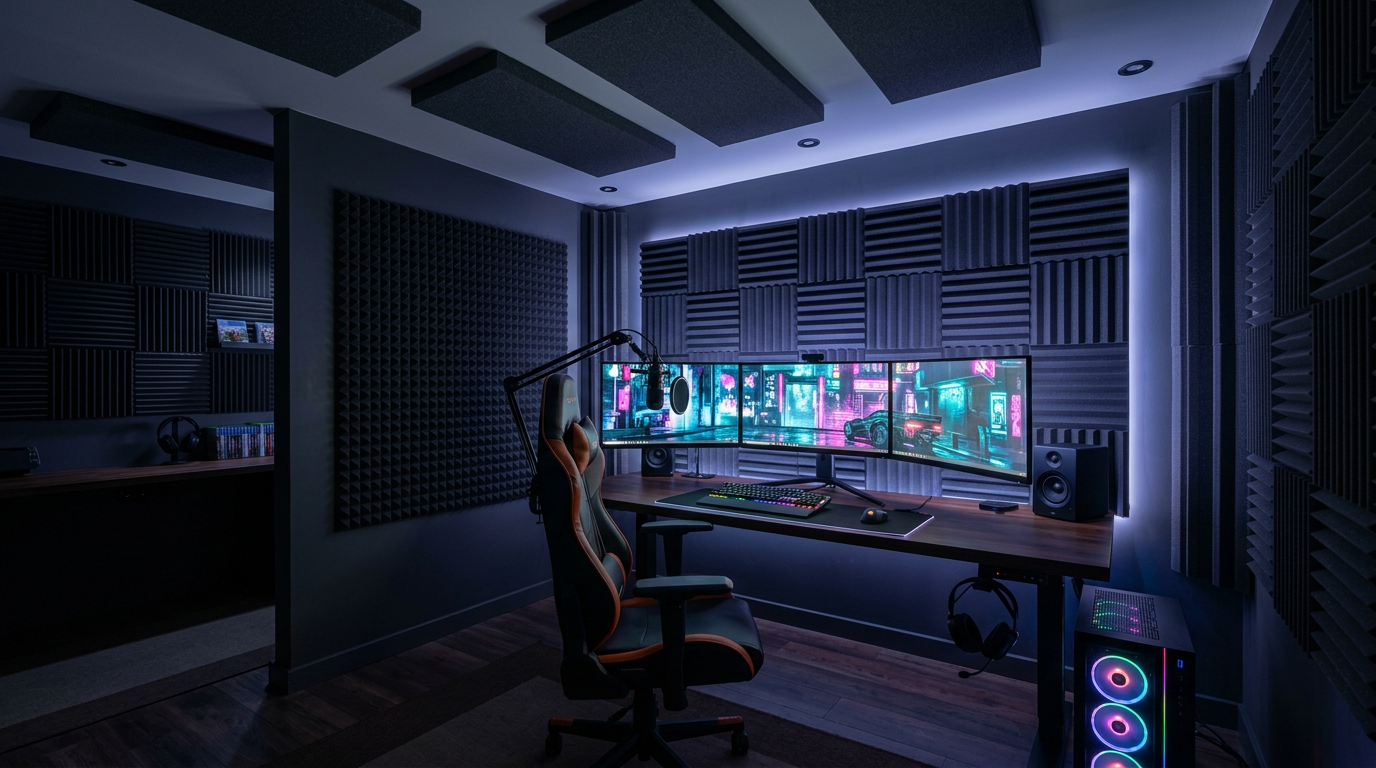
In many gaming rooms, the ceiling should be a priority early on. The ceiling is often a large, hard surface located close to the voice, speakers, and microphone. Ceiling absorbers can therefore provide a noticeable improvement, especially in smaller rooms where sound bounces quickly between surfaces. Wall absorbers complement the ceiling by dampening reflections behind the monitor, on the side walls, and behind the gamer. Proper placement creates a more controlled sound field without making the room feel overly dampened.

At the same time, a gaming room can cause disturbances in other parts of the home. Late-night voices, bass sounds from games, music, keyboard clicks, and chair movements can travel through doors, walls, and floors. Here, it’s important to distinguish between sound absorption and sound insulation. Sound absorption improves the acoustics inside the same room, while sound insulation is a complementary measure when sound needs to be prevented from leaking into adjacent rooms. Sealing around doors, reducing gaps, and adding heavier sound-insulating layers may therefore be necessary if the disturbance is primarily due to sound transmission.

Vibration damping may also be relevant as a supplementary measure. Computers, speakers, subwoofers, desks, and chairs can generate vibrations that travel through furniture, floors, or walls. In such cases, sound absorbers alone are not sufficient, since the problem is not limited to sound reflections in the air. A well-thought-out solution therefore combines sound absorption as the primary measure with sound insulation and vibration damping where it’s actually needed.

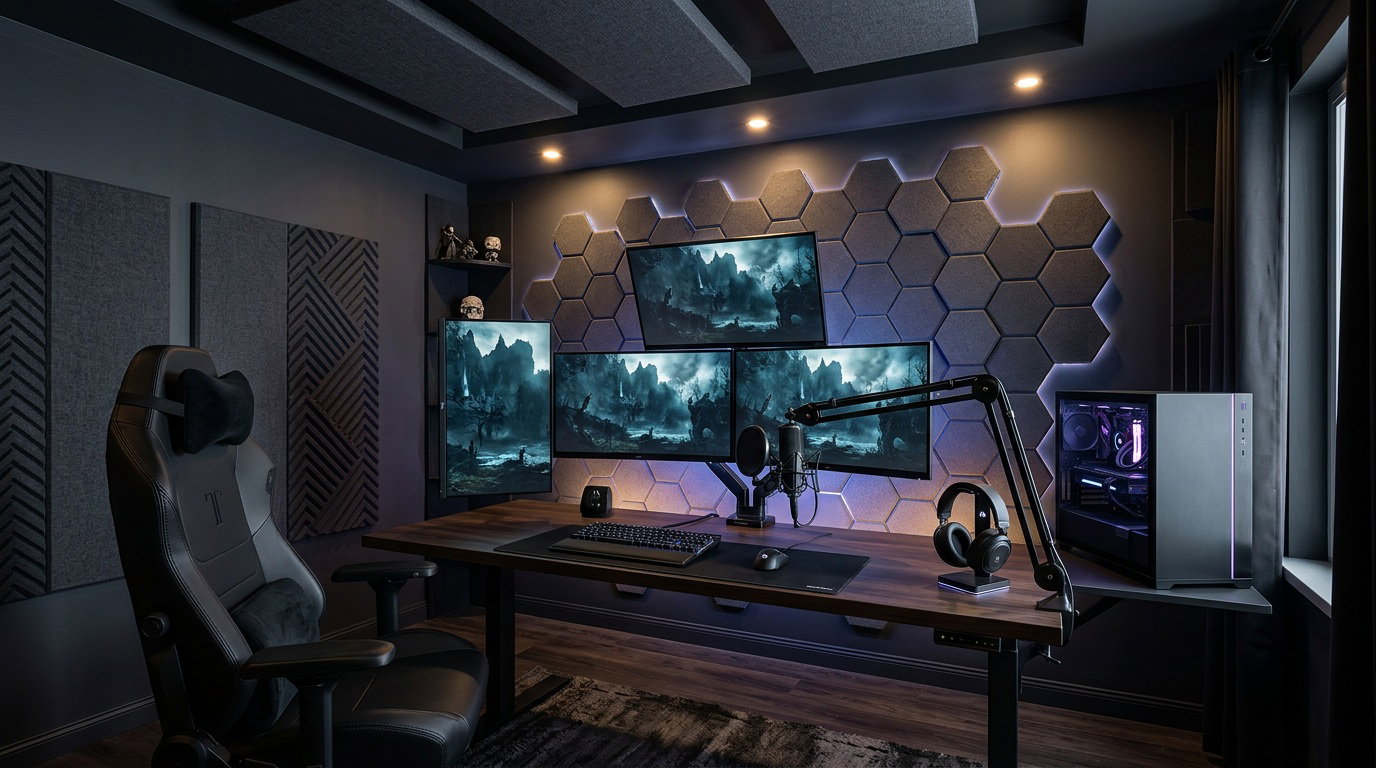
With the right products and placement, a gaming room can achieve better sound quality, clearer voice communication, less echo, and a calmer atmosphere without sacrificing its style. Absorbers can be customized to match the room’s colors, lighting, and technical equipment, ensuring the solution is both practical and visually appealing.

Recommended Products

The Benefits of Soundproofing a Gaming Room.

A clearer voice through the microphone
Sound absorption reduces harsh reflections around the playing area, making the voice sound cleaner and less tinny during voice chat, streaming, and recording.

Less echo and reverberation in the room
Ceiling and wall absorbers help the room sound more controlled by dampening reflections from ceilings, walls, screens, and other hard surfaces.

More comfortable sound levels during long gaming sessions
When sound doesn’t bounce around as much between surfaces, the room becomes less tiring to be in, even when the computer, games, voices, and equipment are all active at the same time.

Better conditions for streaming and recording
More controlled acoustics allow the microphone to pick up more of the voice and less of the room’s reverberation, resulting in a more professional sound.

Less disturbance to adjacent rooms
Sound insulation with sealing, sound-absorbing layers, and the right materials reduces the risk of voices, music, and game sounds spreading to the rest of the home.

Better control over doors and gaps
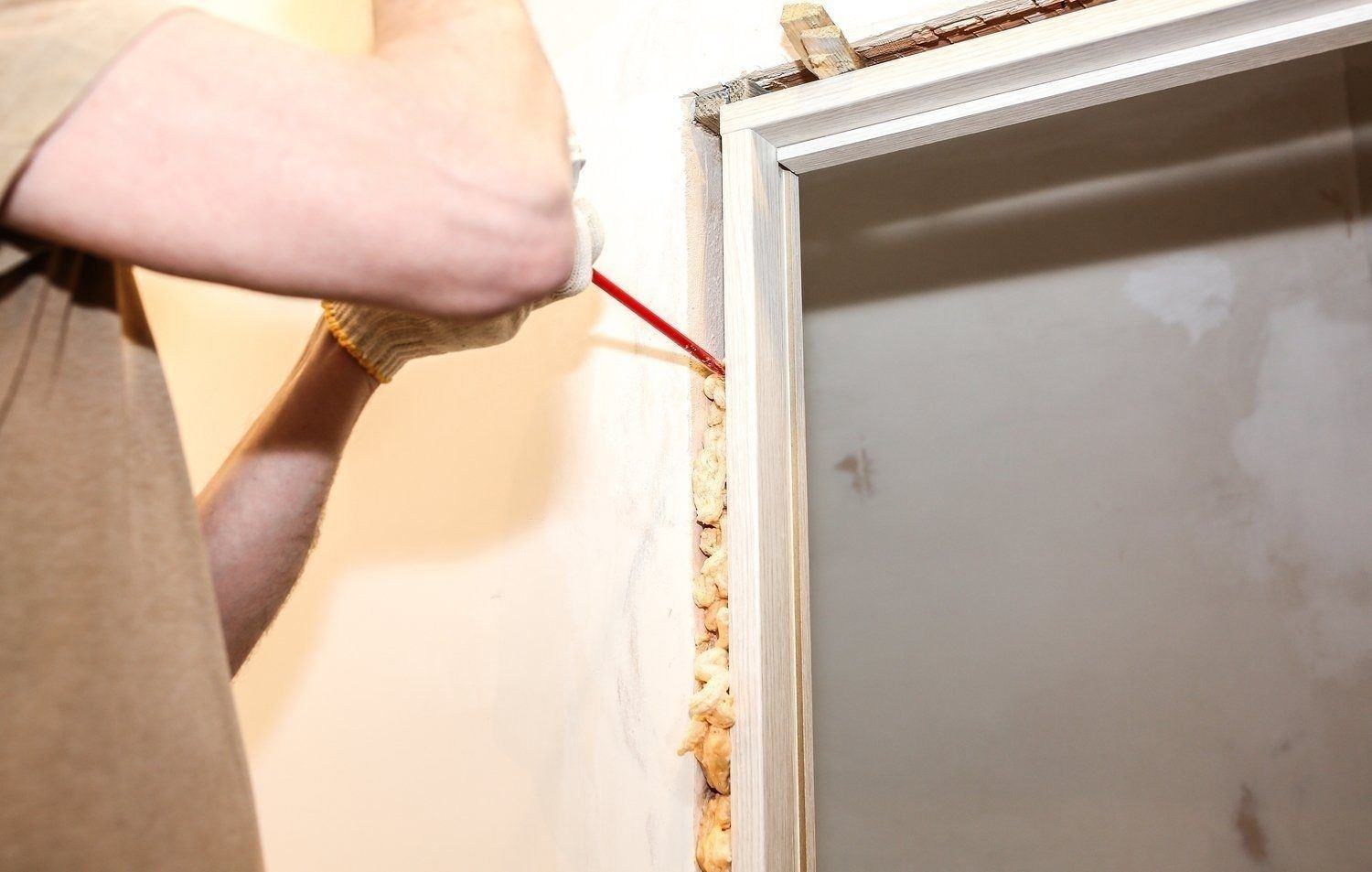
Sealing around the door, frame, trim, and door bottom is often a key foundational measure, as even small openings can allow a significant amount of airborne sound to pass through.

More flexible use of the room
When both acoustics and sound transmission are addressed, the gaming room can function better as a playroom, teen room, streaming room, hobby room, or small home studio.

Stylish integration with the gaming environment
Sound-absorbing products can be placed on ceilings and walls in a way that complements monitors, LED lighting, desks, and the room’s overall aesthetic.

Step-by-Step: How to Effectively Soundproof Your Gaming Room

Step 1: Determine whether the problem is related to acoustics or sound propagation

Start by distinguishing between two different issues. If voices sound harsh, the room echoes, or the microphone picks up a lot of room reverberation, the issue is primarily one of sound absorption. In that case, you need to reduce reflections inside the gaming room. If people in other rooms are bothered by voice chat, game music, bass sounds, or keyboard noise, the issue is sound insulation. In that case, you need to reduce sound leakage through doors, walls, floors, ceilings, and gaps.

Listen both inside and outside the gaming room while the sound sources are playing at normal volume. Test voice chat, speakers, the keyboard, chair movements, and any subwoofer. Mark where the sound reflects the most inside the room and where it’s heard most clearly outside the room. This assessment ensures that the right product goes in the right place and that sound absorption isn’t mistaken for sound insulation.

Step 2: Start with ceiling absorbers if the room has a hard ceiling

In many gaming rooms, the ceiling is a large reflective surface above desks, monitors, and the gaming area. Therefore, ceiling absorbers are often an important first step in reducing echoes, reverberation, and harsh reflections. Place ceiling absorbers above or near the gaming area, especially where voice, speakers, and the microphone interact. Ceiling Sound Absorption - PES Ceiling is ideal when you want to reduce reverberation from the ceiling surface and create more controlled acoustics.

If the room has particularly pronounced reverberation, high noise levels, or is used for streaming and recording, Ceiling Sound Absorption - PES Ceiling Deep Absorb be an option where a deeper ceiling absorber is suitable. Ceiling absorbers improve the sound environment inside the gaming room, but they do not primarily prevent sound from leaving the room.

Step 3: Add wall absorbers around the gaming area

Once the ceiling has been treated, the walls around the gaming area should be addressed. Side walls, the wall behind the monitors, and the wall behind the gamer can create reflections that make the voice less clear in the microphone. Wall sound absorption—PES wall is suitable for larger wall surfaces where you want to reduce echo and create a softer acoustic environment. For more design-oriented placement, you can use Wall Sound Absorber – Wall Rectangle (Landscape) be used as a visible part of the room’s decor.

Do not place all absorbers on the same wall if sound is reflected from multiple directions. A balanced placement often makes the room sound more even and pleasant. In smaller gaming rooms, absorbers on the wall behind the player can be particularly valuable, as the microphone would otherwise easily pick up reflections from behind.

Step 4: Seal doors, door frames, and gaps to reduce sound leakage

When sound disturbs other rooms, sealing should be one of the first soundproofing measures taken. Small gaps around doors, door frames, and windows can let voices and high-frequency sounds from keyboards and mice escape. Sealing Strip for Windows & Doors - SilentDirect Seal 20 meters is used to seal gaps and reduce sound leakage where airborne sound would otherwise pass through.

If there is a noticeable gap under the door leaf, you can Door Bottom Sealing Strip - SilentDirect Seal Door be a practical addition. Sealing does not improve the reverberation inside the room in the same way as absorbers, but it can be crucial for reducing sound that escapes from the gaming room.

Step 5: Reinforce the wall, door, or floor if sound is still escaping

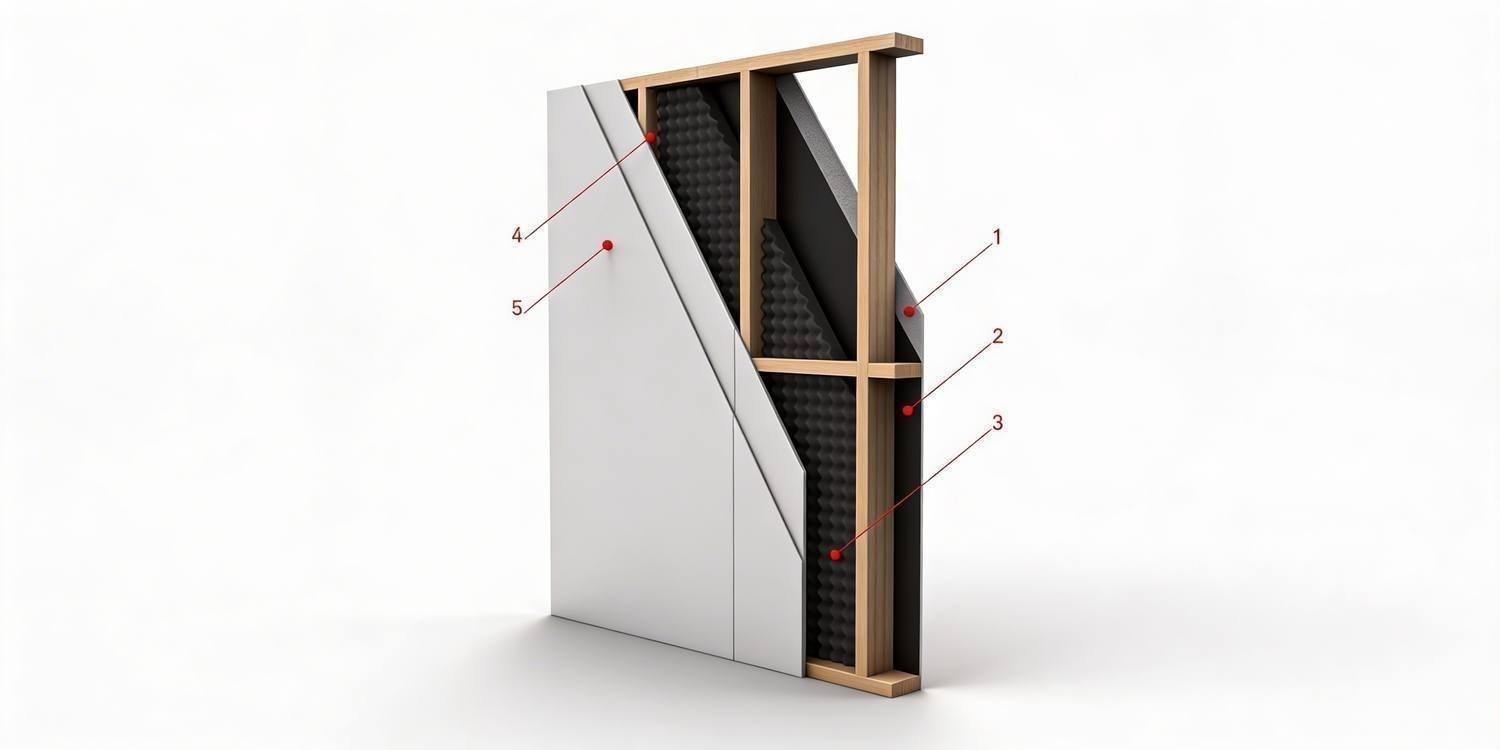
If voices, music, or bass sounds are still clearly audible in adjacent rooms after sealing, heavier soundproofing materials may be needed. Sound Insulation - SilentDirect MLV is suitable when you want to add mass to dampen airborne sound in, for example, walls, doors, or layered structures. The product is not used to reduce echoes inside the room, but to contribute to sound insulation between rooms.

For hard surfaces, resonant panels, or structures that require both sound-blocking and damping support, Sound-insulating damping mat—SilentDirect Polaric be considered. It is suitable where the structure requires more damping and weight, such as in certain door, wall, or furniture solutions. The choice should be based on where the sound is actually traveling.

Step 6: Address hidden sound sources and resonances from equipment

Computer cases, speakers, subwoofers, desks, and chairs can create resonances or mechanical noise that amplify the perception of disturbance. Where there are smaller enclosed spaces, technical components, or surfaces that need to be dampened, Sound Insulation - SilentDirect Egg be used as a complementary solution. For vibrations, resonances, and mechanical noise, Sound Insulation - SilentDirect Neo be a relevant supplementary measure.

Vibration damping should not replace sound absorption or sound insulation, but it can complement the overall solution when equipment or furniture sets surfaces in motion. This is particularly relevant if bass sounds, fan noise, or vibrations are perceived more strongly in adjacent rooms than inside the gaming room.

Step 7: Use screening when the room requires a flexible solution

If the gaming room is shared with other activities, is located near an open area, or requires temporary screening, you can use Sound-absorbing noise barrier—SilentDirect Sound Barrier 2.48 m be used as a flexible sound-dampening solution. It can be useful when you need to block off a sound source or create a clearer boundary in a more demanding environment.

Keep in mind that screening is not a substitute for sealing doors or acoustic treatment of ceilings and walls. It works best as a complement when sound needs to be blocked in a specific direction or when the gaming environment needs to be adaptable without permanent modifications.

Step 8: Evaluate the results and adjust the placement

Once ceiling absorbers, wall absorbers, and soundproofing measures are in place, the room should be tested again. Play back the same audio, use the same microphone settings, and listen in adjacent rooms. If the voice still sounds harsh, more absorbers may be needed on the walls or ceiling. If sound is still leaking out, the door, door frame, openings, walls, or floor should be checked again.

The best solution is rarely a single product in a single location. A gaming room is most functional when sound absorption improves the acoustics inside the room and sound insulation reduces sound leakage to the surrounding area. This way, you’ll have a room that works better for gaming, voice chat, streaming, recording, and long sessions without unnecessary disturbances.

How many sound absorbers do you need in a gaming room?

How many sound absorbers do you need?

With our free sound absorption calculation tool, you can quickly and easily calculate how many sound absorbers are needed to effectively reduce echoes and disruptive noise in various environments, such as offices, rooms, or other spaces.

Did you know that…

A gaming microphone picks up not only your voice but also the room’s response to it. That’s why the same microphone can sound clear in an acoustically controlled room but harsh, thin, or tinny in a room with bare walls and a hard ceiling.

The ceiling is often overlooked in gaming rooms, even though it’s a large reflective surface close to your voice, speakers, and listening position. That’s why ceiling absorbers can make a noticeable difference even when the walls already have some furnishings.

A small gap around a door can be more important than it appears. Airborne sound tends to follow openings, making sealing a fundamental part of sound insulation when voices and game sounds carry into other rooms.

Gaming rooms have unique acoustic characteristics because there are often many sound sources located close to the user. Keyboards, mice, fans, speakers, and voices create a dense sound field where both absorbers and sound insulation must be selected to address the specific issues.

Featured Articles

How do you soundproof and insulate doors?

What is the difference between sound insulation and sound absorption?

How do you soundproof a room with sound absorbers?

How do you soundproof and insulate a wall?

Products suitable for sound absorption and soundproofing in gaming rooms

A gaming room often requires products for two different purposes. Sound-absorbing products are used to reduce echoes, reverberation, and harsh reflections inside the room. Sound-insulating products are used to reduce sound leakage and sound transmission to adjacent rooms. By combining the right products, the gaming room becomes better suited for voice chat, streaming, recording, and long gaming sessions.

Sound Absorption for Ceilings - PES Ceiling
This product is ideal when you want to reduce echoes and reverberation from the ceiling surface above the gaming area.

Wall sound absorption - PES wall
This product is ideal when you want to dampen reflections from walls behind monitors, behind the player, or along side walls.

Ceiling Sound Absorption - PES Ceiling Deep Absorb
This product is ideal when you want a deeper ceiling absorber for a gaming room with noticeable reverberation or high demands for acoustic control.

Wall Sound Absorption - PES wall Deep Absorb
This product is ideal when you want to create more controlled wall absorption in a room used for streaming, voice chat, or recording.

Wall Sound Absorber - Wall Rectangle (Horizontal)
This product is ideal when you want to combine sound absorption with a visible and stylish wall solution in a gaming environment.

SilentDirect PET Rectangle 100x50cm
This product is ideal when you want to improve acoustics with an easy-to-install sound absorber on walls or other suitable surfaces.

Soundproofing Mat - SilentDirect Polaric
This product is ideal when you want to enhance sound insulation, dampen resonances, and reduce vibrations in harder surfaces or structures.

Sealing Strip for Windows & Doors - SilentDirect Seal 20 meters
This product is ideal when you want to seal gaps around doors, windows, and trim where airborne sound easily escapes.

Sound Insulation - SilentDirect Egg
This product is ideal for soundproofing and dampening in smaller structures, areas near mechanical systems, or enclosed spaces.

Sound Insulation - SilentDirect MLV
This product is ideal for adding mass to dampen airborne sound in, for example, walls, doors, or layered solutions.

Sound Insulation - SilentDirect Neo
This product is ideal for reducing vibrations, resonances, and mechanical noise that can amplify disturbances from equipment or furniture.

Sound-Absorbing Noise Barrier - SilentDirect Sound Barrier 2.48 m
This product is ideal when you want to create flexible sound barriers or block sound in a specific direction in a more demanding gaming or studio environment.

*Free shipping

Free shipping to a pickup location

5-Year Warranty

5-Year Product Warranty

Fast Delivery

Usually ships the same day

Soundproofing and Sound Absorption for Gaming Rooms

A gaming room is often used for much more than just gaming. It can be a space for voice chat, live streaming, recording, music, video conferences, esports training, and long sessions in front of the computer. At the same time, many gaming rooms are acoustically challenging environments. Hard walls, smooth ceilings, desks, monitors, windows, and limited furniture cause sound to bounce around the room. Voices, keyboards, clicking sounds, speakers, and computer fans can therefore seem louder than they actually are.

Sound absorption makes the gaming room clearer and more comfortable

Sound absorption is the primary solution when dealing with echoes, reverberation, and harsh sound reflections inside the gaming room. Installing sound absorbers on the ceiling and walls reduces the amount of sound bouncing off the room’s surfaces. This makes your voice sound clearer through the microphone, makes voice chat more pleasant, and gives streams or recordings a more controlled sound. For those who game for long periods, a softer sound environment can also reduce fatigue and help you stay more focused.

Start with the ceiling and walls, where sound reflects the most

In many gaming rooms, the ceiling is a large, hard, and empty surface. That’s why ceiling absorbers are often an important first step, especially if the room has a lot of technology but few soft materials. Wall absorbers are then used to reduce reflections behind the monitor, on the side walls, and behind the gamer. Their placement should be adjusted based on the location of the microphone, speakers, and seating position. The goal is not to make the room completely dead, but to create balanced acoustics where voices, gameplay, and music sound more controlled.

Sound insulation is a complementary measure when sound disturbs other rooms

If voices, bass sounds, music, or chair movements spread to the rest of the home, sound absorption alone isn’t always enough. In that case, sound insulation is needed as a supplementary measure. Sound insulation involves reducing sound leakage between rooms through sealing, heavier materials, and better separation. Door gaps, windows, walls, floors, and penetrations are common weak points. Sealing around doors and trim can be an important first step, while heavier sound-insulating layers may be needed if sound is clearly passing through the structure.

Vibration damping can reduce mechanical noise

In a gaming room, vibrations can also contribute to disruptive noise. Computer cases, subwoofers, speakers, desks, chair casters, and equipment resting against hard surfaces can generate structure-borne noise that is transmitted through floors, walls, or furniture. Vibration damping should be viewed as a complement to sound absorption, not as a replacement. However, it can be useful when the problem stems from mechanical vibrations or resonances in equipment and furnishings.

A better acoustic environment without disrupting the room’s design

Sound absorbers can be seamlessly integrated into gaming environments featuring monitors, LED lighting, dark color schemes, desks, and technical equipment. Fabric-covered wall absorbers, ceiling absorbers, and custom-shaped absorbers can be placed discreetly or used as a prominent part of the interior design. For a gaming room that’s also used for streaming or recording, the combination of proper placement, the right number of absorbers, and complementary sealing is often the best way to achieve clearer sound, less echo, and less disturbance to the surrounding area.