





• Free shipping
  • 5-year warranty
  • Fast delivery

Soundproofing Music Rooms and Rehearsal Spaces—Tips for Musicians

Soundproofing a music room or rehearsal space is a different kind of project than simply making a regular room a little quieter. Music often contains loud peaks, low frequencies, vibrations, and sustained sound pressure. Drums, bass amplifiers, guitar amplifiers, vocal systems, and studio monitors can generate both airborne sound and structure-borne sound. Therefore, you need to start by determining which problem is most important: is sound leaking out to neighbors and other rooms, or does the room sound harsh, echoey, and difficult to play in?

Soundproofing is used to reduce sound transmission between rooms and spaces. In a music room, this means working with mass, density, layering, and decoupling. Heavy and dense materials help dampen airborne sound, while sealing around doors, joints, and penetrations reduces sound leakage. For musicians, this is especially important because even small gaps can let a lot of sound through. A well-sealed door, tight joints, and properly constructed walls, ceilings, or floors can therefore make a bigger difference than many people realize.

Sound absorption, on the other hand, is used to improve the acoustics inside the room. Absorbers typically don’t prevent neighbors from hearing drums or bass, but they can reduce echo, reverberation, and harsh reflections. This makes vocals, guitar, drums, and amplifiers easier to hear and control. In a rehearsal space, this can help the band play with better balance, since they don’t have to compensate for a noisy room by turning up the volume.

In practice, a good music room often needs both solutions. First, you should review the soundproofing if the sound is disturbing people outside the room. Next, you can improve the acoustics with absorbers on the ceiling and walls. SilentDirect’s recommendation for general sound absorption is to start with the ceiling whenever possible, since the ceiling surface is often large, unobstructed, and effective at reducing reverberation. Wall absorbers can then be placed where reflections are most disruptive—for example, behind the drums, near amplifiers, or at primary reflection points.

For musicians, it’s also important to consider vibrations. Drum sets, bass cabinets, and speakers can transmit energy down into the floor and throughout the building. This can cause disturbances even if the room otherwise feels relatively well-insulated. Therefore, when dealing with structure-borne noise, one should combine sealing and mass damping with vibration damping under equipment, podiums, or other contact points. The right solution thus depends on the room, the sound sources, the building, and the requirements of the surrounding environment.

Recommended Products

The Benefits of Proper Sound Insulation and Acoustics in Music Rooms.

Less noise leakage to the surrounding area
Well-designed soundproofing reduces the risk of music, drums, bass, and amplifiers disturbing other rooms, neighbors, or businesses adjacent to the rehearsal space.

Better control over low frequencies
When the structure is built to be more airtight and vibration-controlled, it becomes easier to manage bass, bass drum, and other sounds that might otherwise travel far throughout the building.

Clearer sound inside the room
Sound absorption reduces echoes and harsh reflections, allowing musicians to hear each other better and play with greater balance.

Lower perceived rehearsal volume
When the room doesn’t amplify reflections and reverberation as much, the band often doesn’t need to play as loudly to hear the details.

Less tiring sound environment
More even acoustics make longer rehearsals more comfortable and reduce the stress that arises in harsh, bouncy, and noisy rooms.

Better recording conditions
Controlled reverberation and fewer distracting reflections make it easier to record vocals, guitar, drums, and acoustic instruments with a more usable fundamental sound.

Fewer structural weak points
Sealing doors, joints, gaps, and penetrations reduces the risk of sound finding easy paths out of the room.

A more long-term rehearsal space solution
When sound insulation, vibration damping, and sound absorption are planned together, the room becomes more versatile for practice, rehearsals, and simple production.

How to Soundproof and Treat the Acoustics of a Music Room and Rehearsal Space

A good rehearsal space isn’t just built to be quieter to the outside world, but also to be a better place to play. Therefore, work step by step and start with what affects sound leakage the most. Once the room is more soundproof and better controlled, you can add acoustic treatments that make the music clearer inside the room.

1. Identify the biggest problems

Start by distinguishing between three problems: sound leaking out, echoes inside the room, and vibrations traveling down into the building. Play at a normal volume and listen in adjacent rooms. If vocals and guitar are clearly audible through the door, airborne sound and gaps in the walls are likely the main issues. If you can feel the bass and drums through the floor, structure-borne sound and vibrations are a major part of the problem.

2. Seal doors, joints, and penetrations

Music often escapes through small openings. Check door gaps, door frames, baseboards, windows, electrical boxes, and ventilation openings. Use the light test by looking for light leakage along gaps. Use the pressure test by feeling for drafts around doors and openings. Where air passes, sound can often pass as well.

SilentDirect Seal can be used on gaps, joints, and contact surfaces where sound leakage or vibrations need to be reduced. For floor gaps under doors, SilentDirect Seal Door can be a practical alternative. In soundproofing installations, SilentDirect Aluminum Sealing Tape can be used to seal joints where leakage risks compromising the results.

3. Reinforce weak surfaces with mass

If sound travels through walls, ceilings, or floors, more than just absorbers are needed. In such cases, the structure often requires greater mass and density. SilentDirect MLV acts as a heavy sound barrier in structures where airborne sound needs to be dampened. This is particularly relevant when music spreads between rooms.

4. Reduce vibrations from drums, bass, and equipment

Drums, subwoofer cabinets, and amplifiers can generate vibrations that travel through floors and walls. Dampio PRO can be used under equipment that risks transmitting structure-borne sound into hard surfaces. For hard surfaces where resonance and vibrations need to be reduced, SilentDirect Polaric may be a suitable solution.

5. Decouple materials when adding new layers

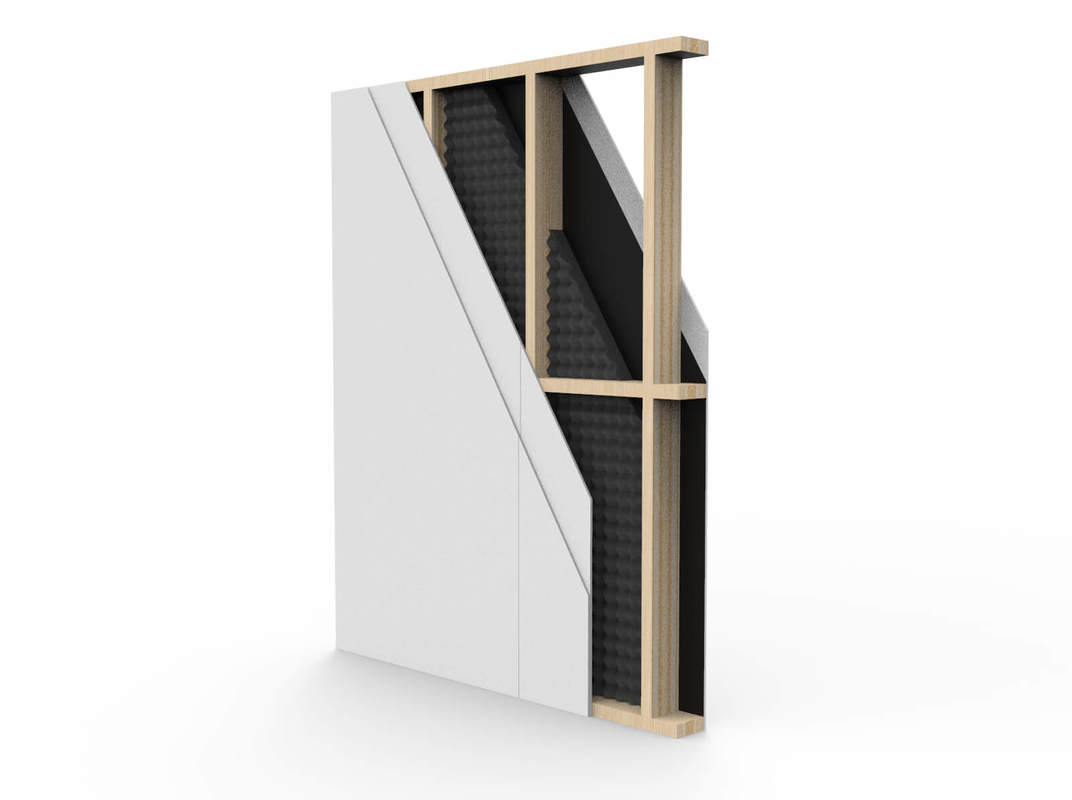
When working with sound insulation and vibration damping, one of the most important principles is to decouple materials from one another. If different building components are in direct contact with each other, vibrations, structure-borne sound, and sound energy can easily be transmitted through the structure. This applies, for example, when constructing a framing system for walls, ceilings, or floors.

To reduce this transmission, the parts of the stud frame that come into contact with other surfaces should first be fitted with a vibration-damping layer. Here, SilentDirect Seal is an effective option. The product is a sealing strip made of nitrile rubber (NBR) and is designed to reduce sound leakage, dampen vibrations, and contribute to a tighter, quieter, and more energy-efficient structure.

6. Soundproof the ceiling first

Once sound leakage and vibrations are under control, you should improve the acoustics inside the room. We generally recommend sound-absorbing the ceiling first before moving on to other surfaces. The ceiling is often a large, unobstructed surface and can have a significant effect on reverberation, cymbals, vocals, and overall sound levels. PES Ceiling Deep Absorb is suitable when the room has more significant acoustic issues or when standard thin soundproofing is insufficient.

7. Treat the walls where reflections are prominent

After the ceiling, you should treat wall surfaces where sound bounces the most. These might be behind the drums, behind the vocal position, on side walls, or behind monitors and amplifiers. PES Wall Deep Absorb is suitable when walls need more effective absorption. For simpler wall surfaces, PES Wall can be a more all-around option.

8. Use textiles and room dividers as a complement

If the rehearsal space has glass partitions, open areas, or requires flexible zoning, sound-absorbing textiles can be a great complement. Silent Curtain Feltra can soften the impact of windows and open areas, while Silent Divider Feltra can create a more defined and quieter acoustic environment without a solid wall.

9. Test the room again and fine-tune

Once the measures are in place, you should play music again and listen both inside and outside the room. If sound is still leaking out, it’s often due to a gap, a door, ventilation, or a weak structural element that requires further attention. If the room still sounds harsh, more absorption is needed on the right surfaces. A music room sounds its best when sound insulation, vibration damping, and sound absorption work together.

Sound Calculation Software

If you're planning sound insulation, vibration damping, or sound absorption, the right calculations can make a big difference. On the page with sound calculation programs, you'll find free tools to help you estimate material usage, calculate surface areas, and plan measures for a better acoustic environment.

Did you know that…

In music rooms, the most common misconception is that sound absorbers automatically provide soundproofing. They can make the room much better for playing by reducing echoes, reflections, and reverberation, but they typically do not prevent loud music from traveling through walls, doors, or floor joists. If neighbors are bothered, you’ll first need to address airtightness, mass, and vibration damping. The absorbers then come into play to make the sound inside the room clearer and more controlled.

Featured Articles

Airtightness is the key to soundproofing!

How do you soundproof and sound-absorb a wall?

How do you soundproof a room with sound absorbers?

How do you soundproof and insulate a ceiling?

Products for music rooms and rehearsal spaces.

Music rooms and rehearsal spaces often require a combination of products: dense, heavy materials to reduce sound leakage; vibration damping for structure-borne noise; and sound absorbers to improve the room’s acoustics. The products listed below are relevant for different aspects of the same system.

SilentDirect MLV is ideal when music sounds need to be dampened using high mass. It is particularly suitable for reinforcing wall, ceiling, or panel structures and reducing airborne sound from sources such as amplifiers, vocals, and drums.

SilentDirect Seal is used to seal gaps and reduce sound leakage. In music rooms, it is particularly useful around doors, joints, and contact points where both airborne sound and vibrations can otherwise escape.

SilentDirect Seal Door is useful when sound leaks under the door. The bottom of the door is a common weak spot in rehearsal rooms, especially when vocals, snare drums, and amplifier noise are clearly audible outside the room.

Dampio PRO is suitable for localized vibration damping under heavy equipment or installations. It can be useful when structure-borne noise from speakers, amplifiers, podiums, or other equipment needs to be reduced.

PES ceiling Deep Absorb is a ceiling absorber designed to reduce echoes and reverberation from the ceiling surface. In music rooms, the ceiling is often one of the most effective surfaces to start with for achieving a clearer and more controlled sound.

PES Wall Deep Absorb is used on walls to reduce reflections and reverberation. It is suitable for side walls, behind drums, near amplifiers, or other surfaces where sound bounces in a disruptive manner.

SilentDirect PET Rectangle is a flexible sound absorber for walls or other suitable surfaces. It’s ideal when you want to gradually build up more controlled acoustics in a smaller music room or rehearsal space.

Silent Curtain Feltra can be used as a complementary sound-absorbing fabric near glass surfaces, hard wall surfaces, or partitions. It improves the room’s acoustic softness and can reduce reflections, but does not replace built-in sound insulation.

SilentDirect Neo Roll is suitable when you want to combine vibration damping with some sound absorption on appropriate surfaces. It can be used in supplementary solutions where mechanical noise and resonances need to be dampened.

SilentDirect Sound Barrier 2.48 m can be useful as a flexible barrier in more demanding environments. It can help isolate and dampen sound, for example, in temporary setups or designated zones within a larger space.

*Free shipping

Free shipping to a pickup location

5-Year Warranty

5-Year Product Warranty

Fast Delivery

Usually ships the same day

How to Create a Quieter and Better Music Room

Soundproofing a music room or rehearsal space involves two things that are often confused: reducing noise that disturbs others and improving the sound environment inside the room. For musicians, both are important. Drums, bass amps, vocals, guitar amps, and high sound levels can travel through walls, floors, ceilings, doors, and ventilation systems. At the same time, a room with a hard acoustic response and a lot of echo can make it difficult to hear details, rehearse effectively, and play with control.

Sound insulation blocks sound between rooms

Sound insulation is used when the goal is to reduce sound transmission to neighbors, family members, offices, other tenants, or adjacent spaces. In such cases, the construction needs to be denser, heavier, and better decoupled. In a music room, SilentDirect MLV may be appropriate when airborne sound needs to be dampened through mass and density. SilentDirect Polaric can be used on hard surfaces where vibrations, resonance, and structure-borne sound need to be reduced.

Sound absorption makes the room a better place to play

Sound absorption does not typically solve the problem of sound traveling through walls, but it can make the music room much more usable. Absorbers reduce echo, reverberation, and harsh reflections inside the room. For rehearsal spaces and home studios, we often recommend starting with the ceiling and then adding wall treatments, especially at primary reflection points, behind drums, and on larger hard surfaces. Products like PES Ceiling Deep Absorb and PES Wall Deep Absorb may be suitable when the room needs more effective absorption.

Sealing and Vibrations Are Crucial

Music easily escapes through door gaps, joints, ventilation, electrical boxes, and connections. Small leaks can compromise the results even if the walls are relatively thick. Therefore, you should inspect the room using the light test and the pressure test: look for light seeping through gaps and feel for drafts around doors, moldings, and penetrations. SilentDirect Seal is suitable for gaps, joints, and contact surfaces where minor air leaks or vibrations need to be reduced, while SilentDirect Aluminum Sealing Tape can be used to seal joints in sound-insulating structures.

Tailor the solution to the instrument and sound level

An acoustic guitar does not require the same measures as a drum set or a rehearsal space with a full band. Drums and bass create both airborne sound and vibrations, while vocals and guitar amplifiers often produce more distinct reflections and midrange issues. Therefore, music rooms should be built in layers: sealing first, followed by mass and vibration damping where the sound needs to be stopped, and finally sound absorption to make the room clearer, quieter, and more musical.