






• Free shipping
  • 5-year warranty
  • Fast delivery

How to Soundproof Your Gym – Reduce Noise During Workouts

Gyms and fitness centers can generate more disruptive noise than one might initially think. It’s not just about music or voices, but also about weights being dropped, treadmills running, machines vibrating, group exercise classes, doors opening, and hard surfaces that reflect sound. In a home gym, the noise can disturb family members or neighbors. In a commercial gym, the sound can spread to offices, residences, treatment rooms, stores, or other businesses in the same building. Therefore, soundproofing a gym needs to be approached holistically, not as a single product or a simple acoustic measure.

The most important thing is to understand what type of sound is causing the problem. Airborne sound is sound that travels through the air, such as music, voices, instructions, fan noise, and machine noise. Structure-borne sound occurs when vibrations travel through the building’s structure—for example, through the floor when someone is running on a treadmill, dropping weights, or using heavy equipment. Reverberation and echoes occur inside a room when sound bounces off hard surfaces such as floors, walls, and ceilings. All three can be present at the same time, but they are not addressed in exactly the same way.

If the noise disturbs other rooms, you must first prioritize sound insulation, sealing, and vibration damping. This involves reducing sound transmission through floors, walls, ceilings, doors, and weak connections. Small gaps around doors, penetrations, and joints can allow a lot of sound to pass through. At the same time, vibrations from exercise machines and weights can travel far through floor joists and walls. Therefore, it’s often wise to start with the areas under the most stress: free weights, treadmills, machine stations, and areas where many people exercise at the same time.

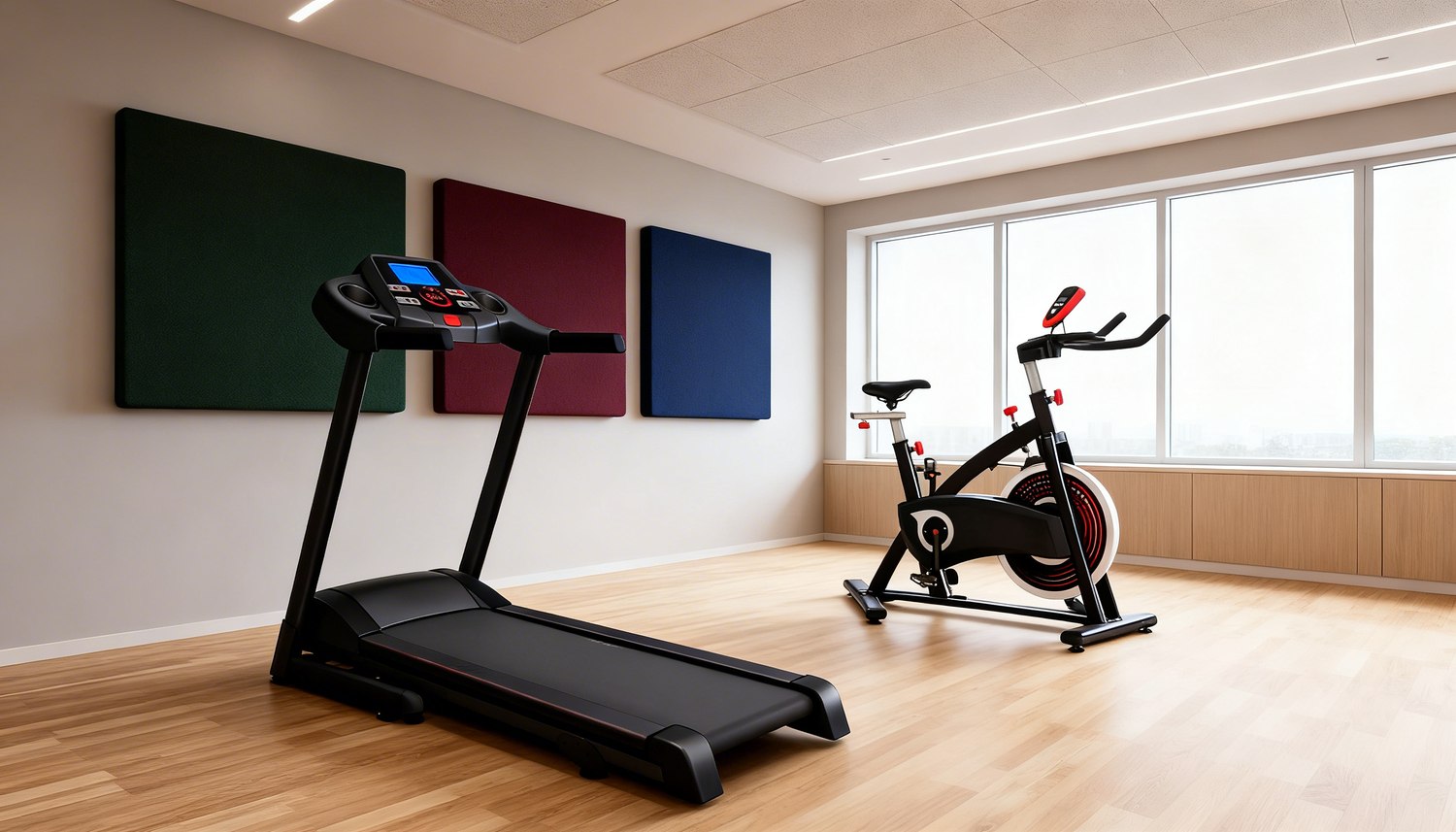
If the main issue is that the gym feels noisy, harsh, and uncomfortable to be in, sound absorption is needed. Sound absorbers on the ceiling and walls can reduce reverberation and make the space more pleasant for both exercisers and staff. SilentDirect’s recommendation for general sound absorption is to often start with the ceiling, since the ceiling area is typically large and does not compete with exercise equipment. Afterward, wall absorbers can be placed on exposed wall surfaces, near group exercise areas, or in zones where sound builds up.

The best solution for a gym is therefore rarely a choice between sound insulation and sound absorption alone. First, you need to reduce the noise and vibrations radiating from the facility, and then improve the acoustic environment inside the room. This way, the gym becomes both more considerate of its surroundings and a more pleasant place to work out.

Recommended Products

The Benefits of Proper Soundproofing in Gyms.

Less disturbance to neighbors and other spaces
Proper sound insulation reduces the risk that exercise, music, machinery, and free weights will disturb residences, offices, or other businesses in the same building.

Better control of structure-borne noise
Vibration damping under equipment and loaded surfaces can reduce the amount of energy transmitted through floors, joists, and walls.

Quieter workout environment
When airborne sound, vibrations, and reverberation are addressed together, the space becomes quieter and more pleasant to be in.

Less sound leakage through doors and gaps
Sealing doors, joints, and openings reduces weak spots where sound can otherwise easily escape.

Better acoustics for group training
Sound absorption can reduce echoes and harsh reflections, making instructions clearer and music less jarring.

A more professional experience
A gym with a controlled acoustic environment is often perceived as more thoughtfully designed, safe, and high-quality by both members and staff.

Fewer complaints from the surrounding community
When the main sources of noise are identified and addressed, the risk of recurring noise disturbances is reduced.

Better conditions for facility planning
By considering noise even when positioning machines, free weights, and group exercise areas, you can avoid many problems before they arise.

How to Reduce Noise and Vibrations in the Gym

To reduce noise in a gym, you need to start by identifying the right problem. A gym can be very noisy due to machines, free weights, impact sounds, music, ventilation, and hard surface finishes. Therefore, the solution should be organized into zones, with each part of the facility treated based on how sound is generated and propagated.

1. Map out the noise in different training zones

Divide the gym into machine areas, free weights, cardio, group exercise, locker rooms, and adjacent rooms. Listen to determine whether the sound is airborne, whether it feels like vibrations in the floor and walls, or whether the space is mostly clattering and echoing. This assessment will determine which measures to prioritize.

2. Start with machines that generate vibrations

Treadmills, rowing machines, pumps, fans, and other equipment should not be placed directly against hard surfaces if they generate structure-borne noise. Dampio PRO can be used under equipment that risks transmitting vibrations into the floor. Always ensure that the machine remains stable even after installation of the damping system.

3. Dampen high-impact floor surfaces

Free weights and jumping exercises create powerful impacts. On hard surfaces where vibrations and resonance need to be reduced, SilentDirect Polaric may be appropriate. For larger areas or longer installations where a smooth sound-dampening mat is more suitable, SilentDirect Neo Roll can be used.

4. Decouple materials where vibrations can travel

When working with sound insulation and vibration damping, one of the most important principles is to decouple materials from one another. If different building components are in direct contact with each other, vibrations, structure-borne noise, and sound energy can easily be transmitted through the structure. This applies, for example, when constructing a framing system for walls, ceilings, or floors.

To reduce this transmission, the parts of the stud frame that come into contact with other surfaces should first be fitted with a vibration-damping layer. SilentDirect Seal is an effective option here. The product is a sealing strip made of nitrile rubber (NBR) and is designed to reduce sound leakage, dampen vibrations, and contribute to a tighter, quieter, and more energy-efficient structure.

5. Seal weak points where sound escapes

If noise is spreading to other rooms, you should check doors, gates, joints, floor connections, ventilation, and penetrations. Use the light test to find gaps and the pressure test to detect drafts. Where air passes, sound can often pass as well. SilentDirect Seal can be used on gaps and contact surfaces, and SilentDirect MLV may be appropriate where the structure needs more mass to dampen airborne sound.

6. Improve acoustics with ceiling and wall absorbers

In larger gym spaces with hard surfaces, sound can become harsh and tiring. Sound absorption reduces echoes and reverberation inside the space, but does not typically stop vibrations from weights and machines. SilentDirect generally recommends starting with the ceiling when improving acoustics. In larger, noisier training environments, PES Ceiling Deep Industry and PES Wall Deep Industry may be suitable options.

7. Tailor the solution to the gym’s use

A gym with free weights requires more focus on floor noise and impact sounds. A gym with many machines requires stable vibration damping beneath the equipment. A group exercise studio needs to address footsteps, jumping, and reverberation. A gym near residential areas or offices requires extra focus on sound insulation between rooms.

8. Test again and reinforce the right zone

Once the measures are in place, you should test the space under actual use. Listen in adjacent rooms, check the floors and walls for structure-borne noise, and assess whether the room still sounds too loud. If the problem is thudding and vibrations, more vibration damping is needed. If the problem is echo, more absorption is needed. If sound is leaking out through gaps, better sealing is needed.

Sound Calculation Software

If you're planning sound insulation, vibration damping, or sound absorption, the right calculations can make a big difference. On the page with sound calculation programs, you'll find free tools to help you estimate material usage, calculate surface areas, and plan measures for a better acoustic environment.

Did you know that…

In gyms, it’s often structure-borne sound that causes the most serious problems. A treadmill, a dropped weight, or a heavy machine can send vibrations through the floor and joists, even if the room doesn’t seem extremely loud from the inside. That’s why it’s important to distinguish between acoustics and structural transmission. Sound absorbers can make the gym quieter and less echoey, but vibrations from exercise often need to be addressed close to the source through damping, isolation, and proper placement.

Featured Articles

How do you reduce the noise from a treadmill and other exercise machines?

What is the difference between sound insulation and sound absorption?

How do you soundproof a room with sound absorbers?

Airtightness is the key to soundproofing!

Products to reduce noise in gyms.

Gym products should be selected based on the source of the noise. Vibrations from equipment require different measures than airborne noise from music and voices, and harsh room acoustics call for sound absorption. Therefore, a combination of vibration damping, sealing, mass, and absorbers is often the most effective solution.

Dampio PRO is suitable for localized vibration damping under machines and equipment. It is particularly well-suited when the disturbance is perceived as vibrations, thumping, or structure-borne noise from exercise machines.

SilentDirect MLV can be used when the structure requires additional mass to dampen airborne sound. It is suitable for the construction of walls, ceilings, or other layers where sound needs to be better blocked.

SilentDirect Seal is used to seal gaps and reduce sound leakage. In gyms, it is also suitable for contact points where sealing and some vibration damping are needed in a structure.

SilentDirect Seal Door is particularly useful at the bottom of doors, where music, voices, and machine noise often leak out of the gym.

PES Ceiling Deep Industry is suitable for reducing echo and reverberation from ceiling surfaces in larger or more demanding spaces. It is particularly useful in gyms with hard surfaces and high noise levels.

PES Wall Deep Industry is a wall absorber for hard wall surfaces where sound bounces off. It can be used in free-weight areas, group exercise classes, or other noisy zones.

SilentDirect Neo roll is suitable for addressing vibrations, resonances, and the need for sound absorption on appropriate surfaces. It can serve as a complement in solutions where mechanical noise is part of the problem.

SilentDirect Sound Barrier 2.48m can be used as a flexible barrier in demanding environments. It’s ideal for creating zones or dampening noise around specific training areas.

SilentDirect PET Rectangle can be used to improve acoustics on wall surfaces in smaller gyms, home gyms, or areas where reverberation and harsh reflections need to be reduced.

PES Ceiling is a ceiling absorber designed to reduce echoes and reverberation from ceiling surfaces. It is ideal when a gym requires a more controlled and comfortable acoustic environment.

*Free shipping

Free shipping to a pickup location

5-Year Warranty

5-Year Product Warranty

Fast Delivery

Usually ships the same day

How to Reduce Noise and Vibrations in a Gym

Soundproofing a gym is often more about vibrations and structure-borne noise than about general ambient noise. Treadmills, rowing machines, free weights, barbells, jumping, exercise machines, and group workouts can generate noise that travels through floors, walls, and ceilings. In larger gyms, sound can also bounce off hard surfaces, making the environment noisy, tiring, and uncomfortable to be in during longer workouts. That’s why it’s important to distinguish between soundproofing, sound absorption, and vibration damping when planning measures.

Vibration damping is often the first step

In gyms, a lot of noise is generated when equipment is in direct contact with the floor. Machines, treadmills, and weights can transmit vibrations down into the building, causing the sound to be heard or felt in adjacent rooms. For machines and equipment that transmit vibrations down into the floor, Dampio PRO may be a suitable solution. On hard surfaces where a thin barrier, sealing, and vibration damping are needed, SilentDirect Polaric can be used.

Sound insulation is needed when sound travels between rooms

If noise from the gym disturbs offices, residences, treatment rooms, or other spaces, sound insulation is necessary. This involves reducing sound transmission through floors, walls, ceilings, doors, ventilation systems, and weak connections. SilentDirect MLV may be suitable for structures where airborne sound needs to be dampened through mass and density. SilentDirect Seal can help with gaps, joints, and contact surfaces where small air leaks or vibrations can compromise the result.

Sound absorption improves the acoustic environment inside the gym

Sound absorption does not typically stop structure-borne noise from weights or machines, but it can make the gym significantly more pleasant. In gyms with concrete, glass, sheet metal, hard walls, and open spaces, ceiling and wall absorbers can reduce echoes, clatter, and long reverberation. SilentDirect typically recommends starting with the ceiling when improving acoustics and then adding wall absorbers where sound clearly bounces off surfaces.

The right solution depends on the training area

A gym with free weights often requires more powerful sound absorption near the floor than a gym that primarily uses machines. A group exercise area needs to handle jumping and stepping, while a machine area requires stable vibration damping beneath the equipment. For best results, the gym should be divided into zones, and each zone should be treated according to the actual sound source: machines, free weights, cardio training, group exercise, wall reflections, ceiling reflections, or sound leakage into other rooms.