• Free shipping
  • 5-year warranty
  • Fast delivery

Sound Absorbers – What Does the Class A Requirement Mean?

Sound absorption Class A is the highest of the A–E classes under EN ISO 11654. It summarises the absorption of a tested product or construction. If you want to reduce reverberation in an office, classroom or meeting room, the class helps you compare documented solutions. Read it alongside frequency data and mounting details to assess how the solution suits your room.

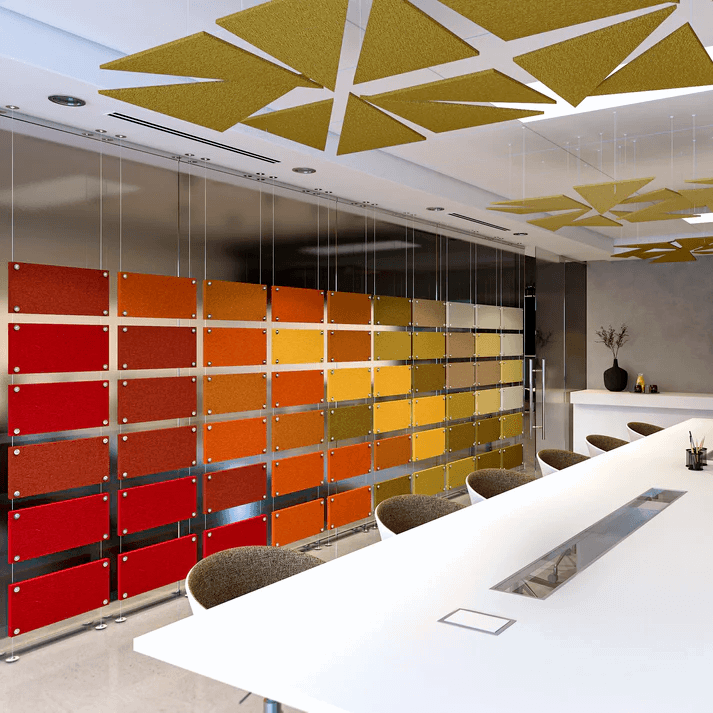
SilentDirect primarily recommends ceiling installation when planning room absorption. Ceiling absorbers capture some of the energy that would otherwise reflect from the ceiling back into the room. With enough absorption and suitable placement, reverberation can become shorter and conversation clearer. Wall absorption complements this where wall reflections remain or ceiling space is limited.

Ceiling sound absorption – PES Ceiling is our recommended starting point. It has a 50 mm polyester core and comes in basic and fabric-covered versions. Choose flush mounting, spacer brackets or wire suspension from the product’s options. The ceiling substrate, available height and fixings must suit the installation. Our placement recommendation is separate from the performance of a specific tested configuration.

Absorption depends on material structure, thickness, surface layers and frequency. A porous absorber converts some sound energy into heat as air moves through it. Distinguish the panel thickness, the air gap behind it and the total construction depth from substrate to front face. An air gap can improve absorption, especially at lower frequencies, but assess the effect for the actual product and mounting.

Both PES Ceiling’s and PES wall’s product pages link to a shared PES coefficient sheet. It reports equivalent absorption area per object under ISO 354 and ISO 20189 for stated sizes and surface mountings. For PES 1200 × 600 × 50 mm, it compares flush mounting at 50 mm total depth with spaced mounting at 100 mm total depth. The latter means a 50 mm air gap, not 100 mm.

At 125 Hz, the sheet gives 0.3 and 0.4 m² Sabine per object respectively for these mountings. These figures help you compare the absorptive contribution of the stated PES size. They describe those mounting cases and must not be transferred to other sizes or an arbitrary wire suspension. PES wall with a 50 mm core is a complementary option for wall reflections, planned alongside ceiling absorption.

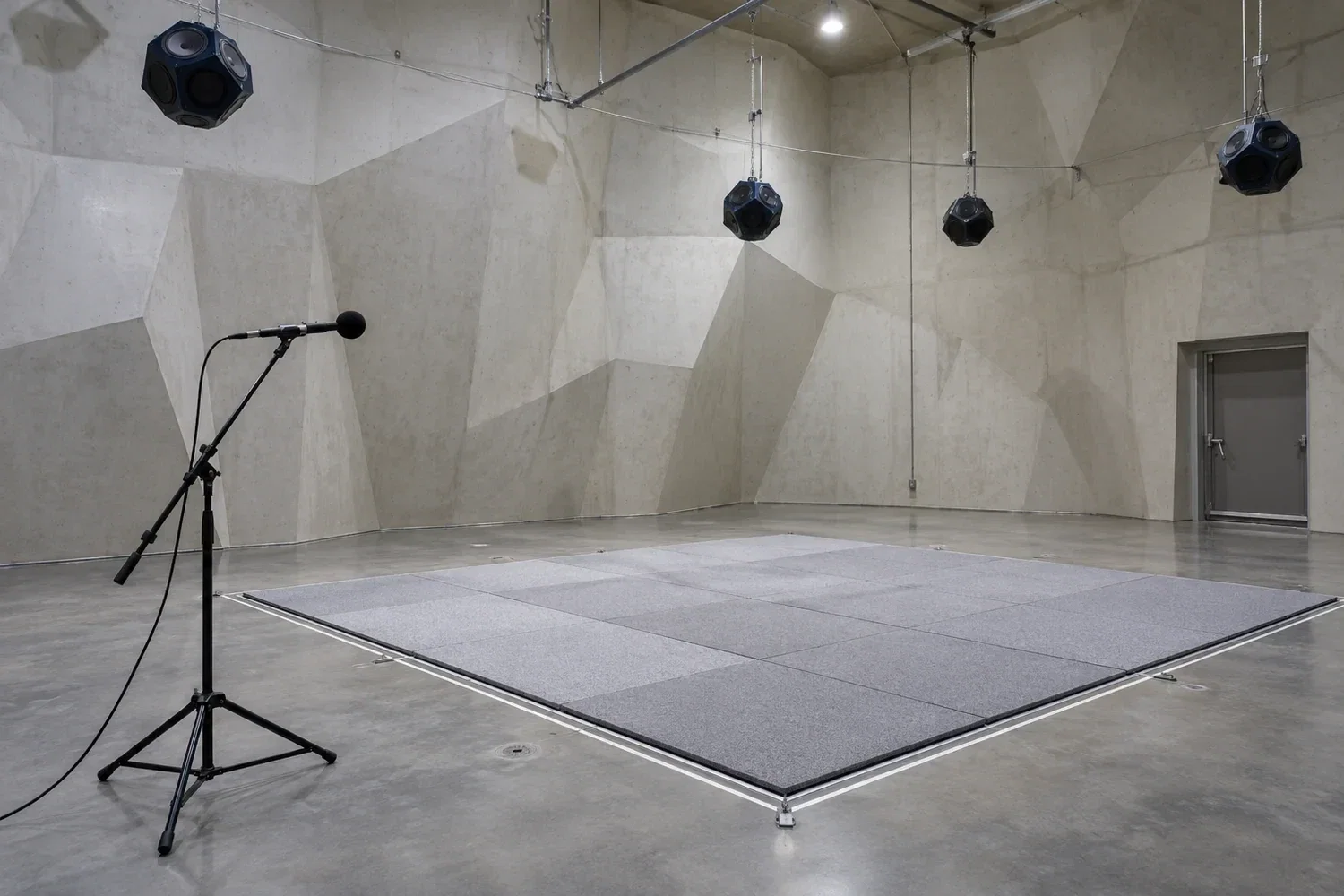
A thickness of 50 mm alone does not determine the A–E class. ISO 354 concerns absorption measurement, ISO 20189 the evaluation of objects among other things, and EN ISO 11654 the classification itself. Start by comparing PES Ceiling for the ceiling and read the knowledge section below. Then choose quantity, placement and documented mounting to suit the room and any project requirements.

Recommended products

Compare the PES wall and its mounting options

PES Ceiling – our top choice for ceiling absorption
Ceiling sound absorption – PES Ceiling features a 50 mm polyester core and is available in a basic or fabric-covered finish. Ceiling absorption can reduce ceiling reflections and help shorten reverberation time when the quantity and placement are appropriate for the room. Flush-mounting brackets provide approximately 50 mm of total installation depth. Spacer brackets provide approximately 50 mm of air gap and approximately 100 mm of total installation depth. Wire suspension is a separate installation option. Follow the ceiling installation instructions and select the appropriate fasteners for the substrate; ceiling screws and ceiling hooks are selected separately. Acoustic values must be matched to the installation method and format specified in the document.

PES wall – a relevant complement for walls
Wall sound absorption – PES wall features a 50 mm polyester core and various installation options. Use wall absorption to complement the ceiling solution where the room’s needs warrant it, such as in cases of pronounced reflections between hard walls or limited ceiling space. Compare the product’s current formats, finishes, and installation instructions.

Common PES values for specified sizes and installation methods
The PES coefficient sheet linked from both products reports the equivalent absorption area per unit in accordance with ISO 354 and ISO 20189. For 1200 × 600 × 50 mm, the value at 125 Hz is 0.3 m² Sabine for flush mounting and 0.4 for spaced mounting with a total depth of 100 mm. Compare these specified installation scenarios. A different format or mounting method must be evaluated using corresponding data. A–E classification is reported in accordance with EN ISO 11654 for the classified version.

Understanding Class A, Materials, and Installation Depth

Ceiling absorption is SilentDirect's top recommendation

We primarily recommend incorporating sound absorbers into the ceiling design. An absorbent ceiling surface absorbs sound energy that would otherwise be reflected back into the room. The right amount and distribution can thus reduce sound reflections and shorten reverberation time. The ceiling surface also leaves the walls available for other functions. Ceiling sound absorption—PES Ceiling is an option with a 50-mm polyester core to start with.

Our recommendation pertains to placement within the room. A test report, on the other hand, describes a specific product format and a specific construction. Keep these issues separate when choosing an installation method. PES wall for wall absorption is a relevant complement in cases of residual wall reflections, limited ceiling space, or other room requirements.

What does sound absorption class A mean?

EN ISO 11654 describes how sound absorption is evaluated using, among other things, the weighted sound absorption coefficient αw and classes A–E. A is the highest class. The classification applies to the specific configuration that was tested: the material, surface finish, dimensions, and installation together form the acoustic structure. The class provides a useful summary, while frequency data offers more insight into how absorption is distributed.

The room’s acoustic environment is also influenced by the number of absorbers, their placement, the room volume, and the other surfaces. Absorption reduces reflected sound and reverberation. Sound insulation between rooms and fire properties are assessed separately based on their respective functions and specifications.

Material, thickness, and frequency interact

In a porous absorber, factors such as pore structure, airflow resistance, and surface layer affect how sound energy is absorbed. Greater material thickness can improve performance at lower frequencies, but two products of equal thickness may have different absorption curves. Therefore, compare both the material design and the frequencies that are important for the room’s intended use.

A 50 mm absorber can be part of a system that achieves Class A if the tested combination allows for it. Neither the thickness alone nor a specific distance from the wall determines the class. The product’s documented performance provides the answer.

Three different measurements: material, air gap, and total height

Material thickness is the measurement of the absorber itself. The air gap is the free space from the back of the absorber to the surface behind it. Total construction height, also called total installation depth, is measured from the surface behind the structure to the front of the structure. For a simple flat panel without other layers, the total depth is the material thickness plus the air gap. For more complex systems, follow the reference surfaces specified in the drawing.

The example of the PES panel with 50 mm of material and a total depth of 100 mm thus implies a 50 mm air gap behind the material. The total height of 100 mm should not be confused with the air gap. These measurements allow you to compare the sample’s installation with the space available on your wall.

Why can spaced installation improve absorption?

Near a hard wall, the movement of air particles is restricted. When a porous material is moved away from the wall, it can operate where movement is greater at certain frequencies. Therefore, an air gap can improve absorption—especially lower down in the frequency range—without making the panel itself thicker. The effect depends on the overall construction and the frequency; greater distances do not provide the same improvement across the board.

For the PES format 1200 × 600 × 50 mm, the standard coefficient sheet shows values at 125 Hz of 0.3 m² Sabine per panel for flush mounting and 0.4 for spaced mounting with a total depth of 100 mm. At 250 Hz, the corresponding values are 0.7 and 0.8. The comparison applies to the equivalent absorption area for the same format in the two surface-mounted configurations shown. The values do not represent percentages, an A–E rating, or an arbitrary suspended installation.

How SilentDirect’s measurement values help you compare

The product pages for PES Ceiling and PES wall contain product documentation and installation instructions. Both link to the same PES coefficient sheet. The numerical examples are taken from the PES formats and installation scenarios specified in that shared sheet. The coefficient sheet specifies measurement and evaluation according to ISO 354 and ISO 20189 and shows the equivalent absorption area per object in octave bands. ISO 354 applies to measurements in reverberation rooms; ISO 20189 provides guidance for assessing, among other things, individual acoustic objects.

The object values can be used as a basis for comparing sizes and installation configurations, as well as for planning the amount of absorption in a room. The unit m² Sabine describes the object’s equivalent absorption area. It differs from a dimensionless absorption coefficient per surface area. Use the same reporting method and comparable installation configurations when comparing products.

Review the test results in conjunction with the installation method

Match the product format, material thickness, surface finish, mounting method, and spacing to the installation described. Values for a spaced installation describe that specific configuration. For a project requiring Class A performance, select a classification according to EN ISO 11654 for the appropriate variant and installation conditions; ISO 354 and ISO 20189 values serve their respective roles as measurement and evaluation criteria.

Next, consider the room’s use and the available ceiling areas and supplementary wall areas. Compare PES Ceiling for ceiling absorption and select the placement and quantity using the frequency data. If you need help interpreting the dimensions or matching a solution to the project’s requirements, please include drawings, room dimensions, and the desired installation method when contacting us.

Did you know that…

A laboratory classification and a room’s sound environment describe different levels. The class helps you select a documented construction; quantity and placement, together with the room, determine how it is used.

Selected articles

How many sound absorbers are needed?

How to Effectively Reduce Echo—Smart Solutions for a Better Acoustic Environment

Where should sound absorbers be placed?

We'll help you compare the right solution

Start with PES Ceiling for ceiling absorption and, if necessary, supplement it with PES wall on the walls based on the room’s reflections and intended use. Please include measurements, ceiling height, and the surface material when you contact us. That way, we can help you review the product specifications and compare quantities, placement, and appropriate installation methods.

*Free delivery

Free delivery to a collection point

5-year guarantee

5-year product guarantee

Fast Delivery

Usually ships the same day

From documented product values to better room acoustics

A well-planned acoustic solution starts with how the room is used. Speech intelligibility is important in a meeting room, while other environments may have specific needs lower in the frequency range. Absorption curves help you see how the product contributes at different frequencies. The quantity and placement of the absorbers then connect the product’s properties to the room.

Compare the same types of information

The weighted sound absorption coefficient αw and the A–E classification according to EN ISO 11654 summarise a tested construction. Equivalent absorption area per object instead describes an object’s absorptive contribution at different frequencies. Both forms of reporting are useful when read for their intended purpose. Compare equivalent measures, formats and installations.

Allow space for the complete construction

Include both the absorber thickness and any air gap in your drawing. The total construction depth is the full distance from the substrate to the front face. Coordinate this with doors, services, fixings and available wall areas. Follow the product’s installation instructions and base the installation on documentation for the selected configuration.

Ceiling absorption first, wall absorption as a complement

SilentDirect primarily recommends ceiling installation of sound absorbers. PES Ceiling can help reduce ceiling reflections and shorten reverberation. Plan the quantity, position and installation to suit the room. Wall absorption provides a complement where it benefits the sound environment.

Find the right PES solution at SilentDirect

On the product pages for PES Ceiling and PES wall, you can compare formats, configurations and mounting options alongside the product attachments. Also explore solutions for the office sound environment. Reliable product information and a clear understanding of the room make it easier to plan a solution that suits both its acoustics and its use.