



• Free shipping
  • 5-year warranty
  • Fast delivery

Airborne noise, structure-borne noise, footfall noise, or reverberation—identify the right noise problem

The terms “airborne sound,” “structure-borne sound,” “impact sound,” and “reverberation” are often used interchangeably, but they describe different ways in which sound energy propagates. The distinction determines whether the measure should be taken in a building component, at a vibrating sound source, in the floor structure, or on the room’s reflective surfaces.

Airborne sound travels first through the air. Voices, music, and traffic noise become a sound insulation problem when they travel to another space through a structure or via gaps and penetrations. Structure-borne sound occurs when vibrations are transmitted through solid materials—for example, from a machine to the floor and onward into the building. Impact sound is a type of structure-borne sound caused by impacts against the floor, such as footsteps, dropped objects, and furniture being moved.

Reverberation differs from the other issues. It describes how long sound reflections linger inside a room. If voices blend together, the room feels harsh, and the sound level builds up quickly, it is often the room acoustics that need to be improved. Sound absorbers reduce reflections but do not normally prevent a neighbor’s music or conversation from passing through a wall.

The same sound source can create several problems at once. A washing machine can produce airborne motor noise, vibrations through the floor, and a harsh sound field in a hard-surfaced laundry room. Therefore, the problem should be assessed before selecting products or design solutions. Note when the sound occurs, where it is loudest, whether you can feel vibrations, and whether the sound is coming from another space or building up in the room where you are standing.

Recommended products.

Four audio issues—four different audio paths:


Airborne Sound

It’s a familiar scenario: Voices, music, or traffic can be heard through or around a building component.

Where the solution usually begins: Increased mass, improved airtightness, and, if necessary, a decoupled structure.

Structure-borne noise

This is a common scenario: Humming, vibrations, or mechanical noise propagate through solid materials.

Where remediation typically begins: At the sound source’s contact points through vibration damping and decoupling.

Impact noise

This is often recognizable: Thuds and impacts accompany footsteps, dropped objects, or furniture being moved.

Where remediation typically begins: In or on top of the floor where the impact occurs, if the structure is accessible.

Reverberation

How it’s often recognized: The sound lingers, speech becomes unclear, and multiple voices blend together in the same room.

Where remediation typically begins: With sound absorbers, usually on the ceiling first and then on other surfaces as needed.

How to Identify the Right Audio Problem

Don't start by choosing materials. Start by figuring out where the sound is coming from, how it reaches you, and whether it's coming from the same room or another space. By making a few simple observations, you can often distinguish airborne sound from structure-borne sound, footfall noise, and reverberation.

Step 1 – Determine whether the sound is coming from the same room

First, listen to see if the problem persists inside the room where the sound is generated. If voices become muffled, clapping produces a long echo, or the sound level rises rapidly when several people are talking, reverberation is a likely cause. In that case, the problem lies primarily in how sound is reflected off the ceiling, walls, floor, glass, and other hard surfaces.

Perform a simple clapping test in several locations. A clear, lingering, or metallic echo indicates a high level of reflections. Next, try temporarily placing thick textiles, mattresses, or other sound-absorbing objects in the room. If the speaking environment quickly becomes quieter, you have a clear indication that sound absorption is needed.

Step 2 – Check if distinct sounds can be heard from another room

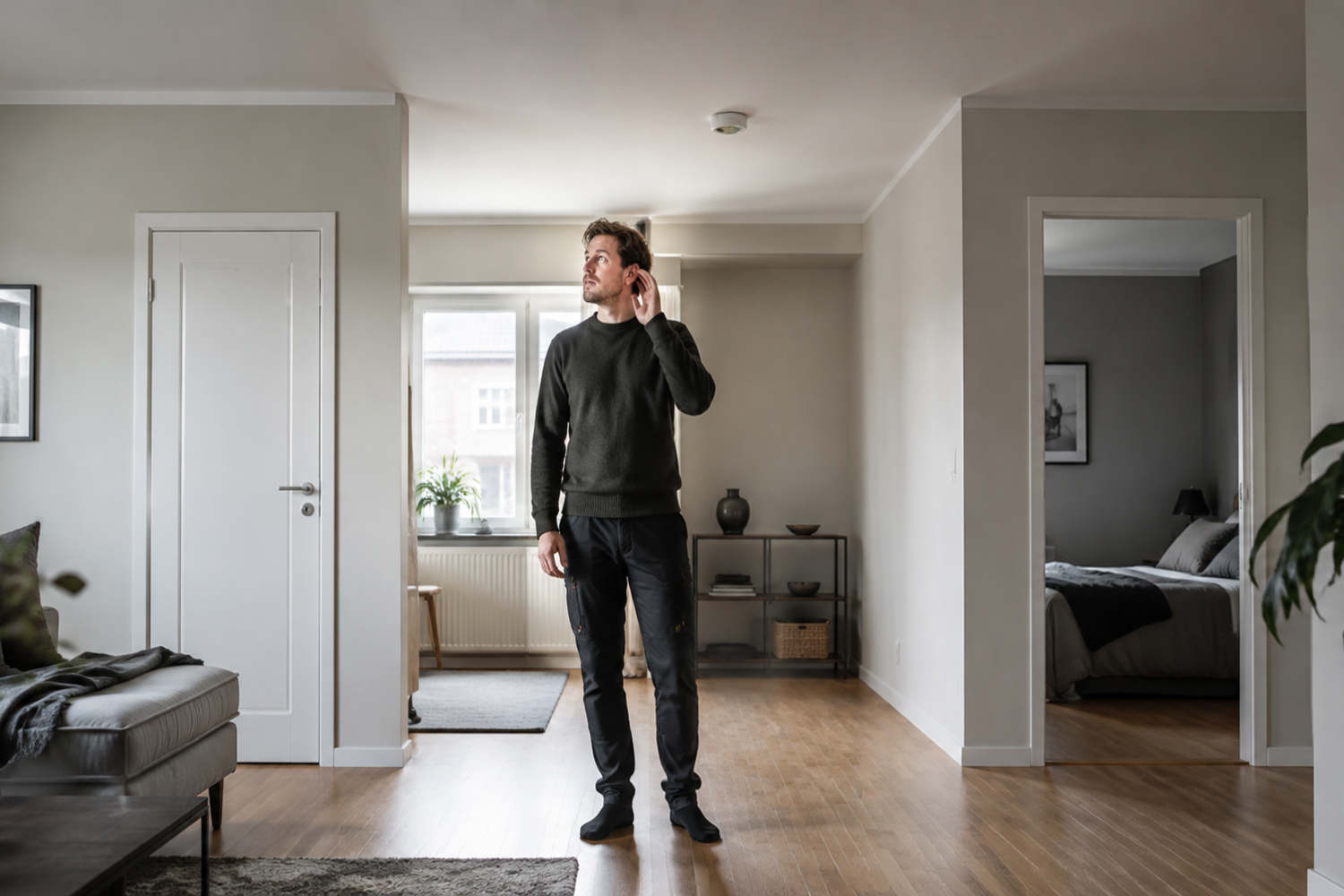
If you can make out voices, music, or TV sound from an adjacent room, it’s usually at least partly airborne sound. Listen near the center of the wall, corners, electrical outlets, doors, windows, and joints where the wall meets the floor and ceiling. If the sound becomes noticeably louder at a crack or opening, even a relatively small gap can be a significant sound path.

Close doors and windows and compare the difference. Feel free to ask someone to create a steady sound on the other side while you move along the structure. Airborne sound usually requires a comprehensive sound-insulating solution. High mass helps the structure dampen sound energy, while airtightness limits leakage around joints and openings.

Step 3 – Determine whether the sound follows the structure

A dull hum or mechanical sound heard in multiple locations may be structure-borne noise. Gently place your hand against the floor, wall, or a nearby structural element and feel for vibrations. Compare the sensation when the machine or equipment is running versus when it is turned off. If the sound changes immediately, you have likely found the source or a key contact point.

Structure-borne noise should primarily be mitigated close to the source. A machine standing directly on a hard floor may require a properly sized vibration isolator. A system that is rigidly attached to the building may need to be decoupled. The principle is the same for walls, ceilings, and floors: direct contact between materials can create a bridge that transmits vibrations.

When working with sound insulation and vibration damping, one of the most important principles is to decouple materials from one another. Parts of a framework that would otherwise rest directly against the floor, ceiling, or wall can be fitted with a vibration-damping layer. SilentDirect Seal is placed at the contact points and contributes to both decoupling and tighter connections. For freestanding machines, Dampio PRO can be placed under the equipment when the load and usage are suitable for the product.

Step 4 – Link thuds to activity on the floor

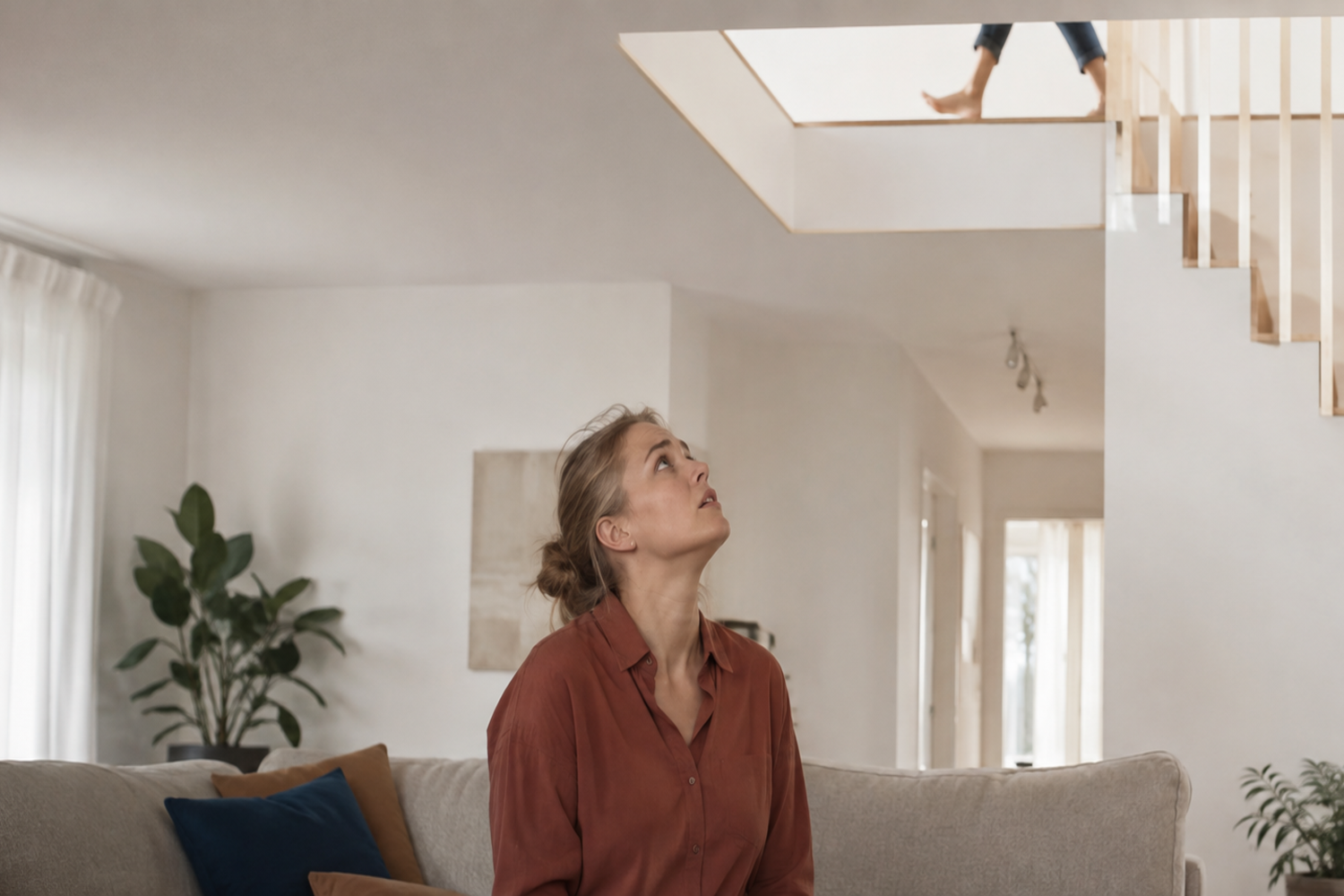
Footfall noise is often recognizable by its rhythm. The sound follows footsteps, jumps, dropped objects, or furniture being moved across the floor. Ask someone to walk on the suspected surface while you listen in the room below and in adjacent rooms. Note whether the sound is a distinct thud, a dull rumble, or a combination of both.

Since footfall noise occurs when the floor is subjected to impact, measures taken close to the source are often most effective. A footfall sound-absorbing layer or a properly constructed floating floor system can reduce the energy transmitted into the floor structure. If the floor above is inaccessible, the ceiling below may need to be improved, but the result will then depend on the entire structure and on any flanking paths through walls and joints.

Step 5 – Check for Multiple Interacting Noise Problems

Turn off a suspected machine, temporarily place vibration-damping material under a contact point, or introduce absorptive material into the room. Change only one thing at a time. If the rumbling decreases but the room still sounds harsh, there is both structure-borne noise and reverberation. If a voice becomes less loud in the room but is still audible through the wall, the absorption has improved the acoustics without resolving airborne sound transmission.

It’s common for a single source to create a chain of problems. An exercise machine may vibrate against the floor, emit airborne motor noise, and simultaneously trigger reflections within the room. The solution may then need to consist of vibration damping at the machine, sound insulation or shielding near the source, and sound absorption within the room.

Step 6 – Choose a measure based on the dominant sound path

Choose sound insulation when sound needs to be prevented from passing between spaces. Choose vibration damping or decoupling when mechanical energy enters the building. Treat impact sound at the floor where the impacts occur, whenever possible. Choose sound absorbers when the problem is echo, long reverberation, or unclear speech within the same room.

For airborne sound, a heavy barrier such as SilentDirect MLV may be appropriate in a properly designed structure. For reverberation, we typically recommend treating the ceiling first. PES Ceiling is suitable for broad ceiling absorption, while PES Ceiling Deep Absorb is a thicker option for larger rooms, high ceilings, or longer reverberation times. Wall absorbers can then be added where wall reflections are pronounced.

Please document the time, source, room, and perceived sound type over the course of a few days. If the sound varies or the transmission path is unclear, such a log provides a significantly better basis for further troubleshooting and selecting a solution.

Calculate the reverberation time.

Calculate the reverberation time.

If you suspect that the problem is reverberation, you can use SilentDirect’s tool to estimate the room’s reverberation time. This calculation helps you distinguish between an acoustic problem within the room and sound transmission through the building, and provides a better basis for determining the amount of sound absorption needed.

Did you know that…

A sound absorber can make voices clearer and the room quieter without significantly reducing noise from the neighbor. Conversely, a well-soundproofed structure can limit sound transmission while still allowing the room to have a long reverberation time. Soundproofing and sound absorption thus address different aspects of the acoustic environment and may need to be combined.

Selected Articles

Eco – Here's How to Reduce Your Eco Footprint

How can you reduce noise and minimize structure-borne noise?

How to Soundproof a Room – A Complete Guide

Products for airborne sound, structure-borne sound, impact sound, and reverberation.

The appropriate product depends on how sound propagates. The products listed below serve different functions: mass and density for airborne sound, damping and decoupling for vibrations, and absorption for reverberation. They should therefore be selected based on the identified sound path and should not be considered interchangeable, universal solutions.

SilentDirect MLV is a heavy barrier for structures where high mass is needed to dampen airborne sound. It is used, for example, between floor joists and is not intended to reduce reverberation in a room.

SilentDirect Seal is a sealing strip for gaps, joints, and contact surfaces. It can reduce small air leaks and create a vibration-damping layer between studs and adjacent building components.

Dampio PRO is placed under machines, pumps, and equipment that would otherwise risk transmitting vibrations directly to the floor. The product is effective for structure-borne noise, not for airborne noise or echo.

SilentDirect Polaric is a self-adhesive barrier mat for sheet metal, metal, and other hard surfaces where mass, sealing, and vibration damping need to be combined.

PES ceiling is a ceiling absorber for rooms where echo and reverberation need to be reduced. The ceiling is typically the surface SilentDirect recommends starting with for general sound absorption.

PES Ceiling Deep Absorb is a 100 mm thick ceiling absorber for larger rooms, high ceilings, and environments where longer reverberation times require greater absorption depth.

PES wall is used to dampen wall reflections, speech noise, and reverberation. It complements ceiling absorption in rooms where the wall surfaces still contribute significantly to reflections.

SilentDirect Neo is a smooth sound-absorbing mat for machinery, vehicles, and enclosures where resonances and mechanical noise need to be dampened close to the source.

*Free shipping

Free shipping to a pickup location

5-Year Warranty

5-Year Product Warranty

Fast Delivery

Usually ships the same day

Learn to recognize airborne sound, structure-borne sound, footfall noise, and reverberation

The right sound solution starts with identifying exactly what your sound problem is. A conversation heard through the wall, vibrations from a washing machine, footsteps from the floor above, and voices that sound muffled in an echoey room can all be perceived as disturbing noises. However, they propagate in different ways and therefore need to be addressed with different methods.

Airborne sound occurs when a sound source sets the air in motion. Voices, music, TV sound, traffic, and barking dogs are common examples. When airborne sound causes disturbance in another room, the sound energy has passed through or around a wall, door, window, ceiling, or floor. In such cases, the structure typically needs to be improved with the right combination of mass, density, and sometimes decoupling. Gaps, penetrations, and leaky joints can allow a surprising amount of sound to pass through, even if the wall itself is relatively heavy.

Structure-borne sound is sound energy that propagates as vibrations through the building or structure. It can originate from pumps, fans, washing machines, exercise equipment, pipes, or other installations that are in direct contact with floors, walls, or ceilings. The sound can be heard far from the source and is sometimes difficult to locate because the vibrations travel along multiple paths through the building. A key principle is therefore to reduce mechanical contact and decouple the sound source or structural components.

Impact sound is a specific type of structure-borne sound caused by impacts and movements against a floor. Footsteps, chairs being dragged, dropped objects, and children playing on the floor cause the floor structure to vibrate. The sound is often most clearly heard in the room below, but can also spread sideways. Therefore, impact sound is best treated at the source, for example, in or on top of the floor where the impact occurs. A measure applied solely to the ceiling below may help in certain structures, but does not always address the most important transmission path.

Reverberation, on the other hand, is primarily an acoustic problem within the same room. Sound is reflected between hard surfaces and lingers after the sound source has fallen silent. The room can feel loud, conversations become strained, and multiple voices blend together. In this case, sound absorbers are usually the most effective solution. SilentDirect primarily recommends sound-absorbing treatment for the ceiling, since the ceiling is often a large, unobstructed surface where reflections can be effectively dampened.

An easy way to distinguish between these problems is to ask where the sound is coming from and where it’s causing a disturbance. If you hear clear voices or music from another space, airborne sound is likely a major factor. If you hear or feel a dull hum that follows the structure of the building, it’s often structure-borne sound. If the thumping sounds occur in time with footsteps or movements on the floor, impact sound is the most likely explanation. If, on the other hand, the sound lingers and makes it difficult to understand speech in the same room, reverberation is the main problem.

Several types of sound can occur simultaneously. For example, an exercise machine can generate airborne motor noise, structure-borne noise through its feet, and reverberation in the room. Therefore, start by observing when the sound occurs, where it is heard most loudly, and whether it changes when doors are closed, machines are lifted off the floor, or soft materials are temporarily brought into the room. This initial troubleshooting makes it easier to choose between sound insulation, vibration damping, impact sound measures, and sound absorption—and reduces the risk of spending time and money on the wrong solution.