

• Free shipping
  • 5-year warranty
  • Fast delivery

How do you soundproof and dampen vibrations in CNC machines?

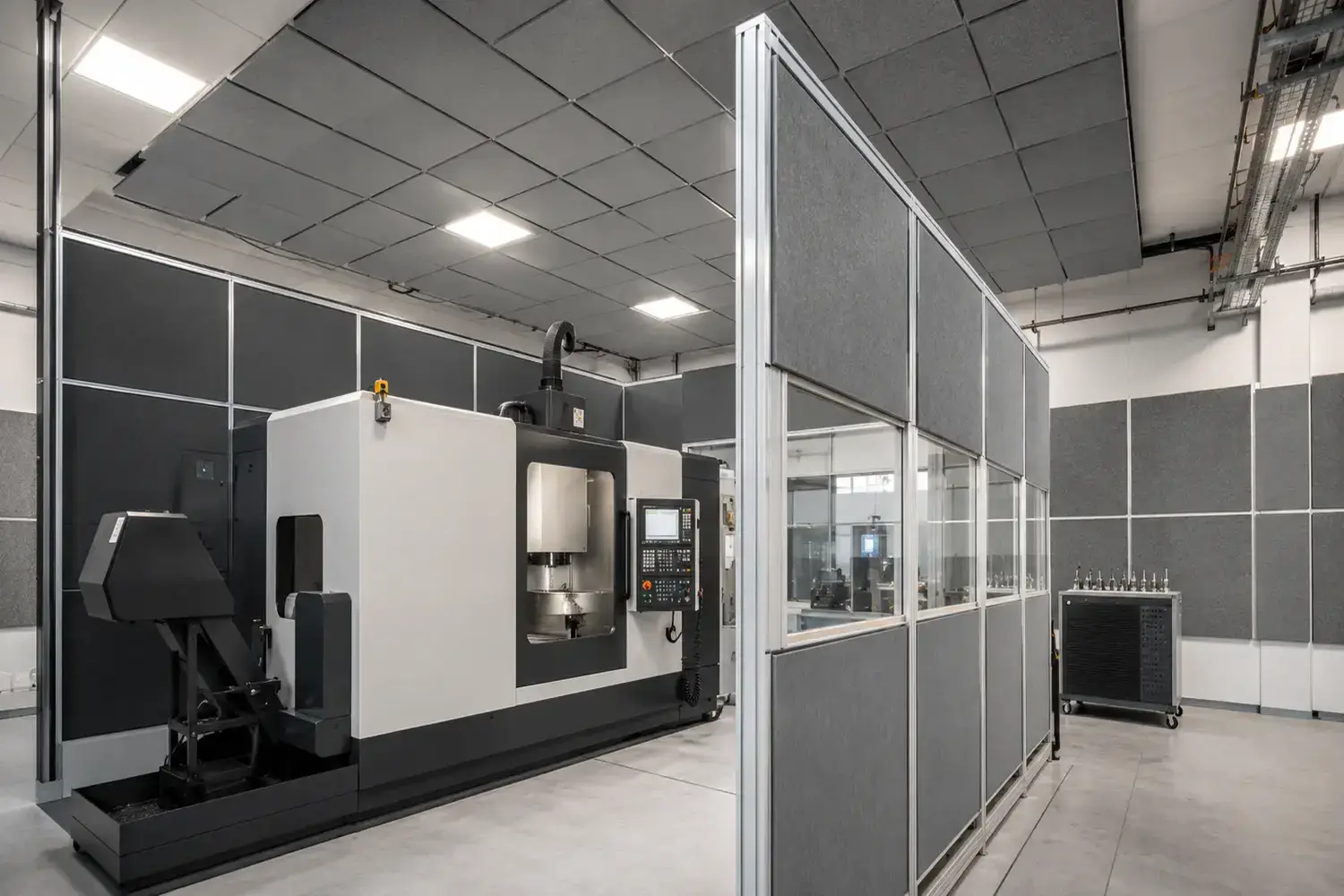
CNC machines can be difficult to soundproof because the noise often comes from multiple directions at the same time. This can include motor noise, spindle noise, tools striking material, clanging from sheet metal or covers, vibrations in the foundation, pumps, fans, ventilation, and resonance in hard surfaces around the machine. Therefore, it is first necessary to distinguish between airborne sound, structure-borne sound, and reverberation in the room.

Airborne sound is the sound heard directly in the room or transmitted through openings, walls, doors, and ventilation systems. Structure-borne sound occurs when vibrations from the machine are transmitted into the floor, foundation, walls, or other building components. Reverberation refers to how sound bounces off surfaces in the room, making the workshop environment sound harsh, clattering, or tiring.

An effective solution should therefore start close to the machine. Machine feet, foundations, and contact surfaces need to be checked first, since vibrations are often a major noise pathway. Next, one should review enclosures, sheet metal surfaces, joints, seals, ventilation, and any noise barriers. Only once the noise source and weak points have been addressed does it make sense to supplement the solution with ceiling and wall absorbers to improve room acoustics.

The goal is not always to make the CNC machine silent, but to reduce the most disruptive sound paths. In some cases, vibration damping beneath the machine is most important. In other cases, sealing, sound barriers, shielding, or absorption within the facility are needed. The best solution is based on addressing each sound problem with the appropriate type of measure.

Recommended Products

Benefits of Soundproofing and Vibration Damping for CNC Machines

Reduces structure-borne noise from the machine
Vibration damping under machine feet and foundations can reduce sound energy that would otherwise be transmitted through the floor and building components. Provides a quieter work environment: Less machine noise, resonance, and rattling make the workshop environment more controlled and less tiring.

Limits noise propagation to other areas
Sealing, massing, and sound barriers can help when CNC noise disturbs offices, adjacent production areas, or other facilities. Reduces resonance in sheet metal and hard surfaces: Damping materials can help when covers, hatches, or metal panels amplify machine noise.

Makes it easier to work near the machine
A quieter environment can make it easier to communicate, monitor the process, and work in the production area.

Can be customized for specific machine types
Milling, turning, encapsulation, pump operation, ventilation, and material processing may require different combinations of sound attenuation.

Provides better results than absorbers alone
When vibrations, sealing, and sound barriers are addressed first, supplementary acoustic measures are more effective. Can be implemented in stages: Start with machine feet and contact surfaces, move on to joints and shielding, and then supplement with room absorption.

How to Soundproof and Vibration-Dampen CNC Machines, Step by Step

CNC machines should be soundproofed systematically. Start with the machine itself and work outward: machine feet, foundations, covers, joints, shielding, ventilation, and finally room acoustics. This reduces the risk of installing sound absorbers in the room when the actual problem is floor vibrations or resonance in the machine’s sheet metal surfaces.

1. Determine whether the problem is airborne noise, structure-borne noise, or reverberation

Listen both near the CNC machine and in adjacent rooms. If the sound is perceived as a whining, screeching, or mechanical noise, airborne sound is the primary issue. If the sound is felt in the floor, walls, or structure, it is often due to vibrations. If the entire workshop sounds harsh and rattling, room absorption is also needed.

2. Check the machine feet and contact with the floor

The machine’s contact with the floor is often one of the most significant noise pathways. If vibrations travel directly into a hard industrial floor, they can propagate far. Dampio PRO can be used under machines and equipment that risk transmitting structure-borne noise further into the building. Always check stability, load capacity, and the machine’s requirements before placing damping under the equipment.

3. Dampen resonance in hard surfaces, enclosures, and metal panels

CNC machines often have sheet metal, metal, hatches, and enclosures that can amplify resonance. On hard surfaces where a thin barrier, sealing, and vibration damping are needed, SilentDirect Polaric may be appropriate. Where a smooth sound-absorbing mat is a better fit, SilentDirect Neo can be used for vibrations, resonances, and mechanical noise.

4. Capture sound near the machine

If the sound comes from a confined technical space, a machine enclosure, or a surface near the sound source, absorptive material placed close to the machine can help reduce reflected sound. SilentDirect Egg is a profiled sound absorber designed for vehicles, machines, and technical spaces where you want to capture sound close to the source.

5. Seal joints, gaps, and penetrations

If the machine is shielded, built-in, or located in a separate space, a tight seal is crucial. Check joints, doors, hatches, cable penetrations, ventilation, and connections. Use the light test to find visible gaps and the pressure test to detect air leaks. SilentDirect Seal can be used on gaps, joints, and contact surfaces where sound leakage or vibrations need to be reduced.

6. Build a sound barrier where airborne sound propagates

If CNC noise disturbs other rooms, more mass and sealing are often needed in the sound path where leakage occurs. SilentDirect MLV acts as a heavy sound barrier in structures where airborne sound needs to be dampened. Joints in sound-insulating structures should be sealed thoroughly, and SilentDirect Aluminum Sealing Tape can be used where aluminum-clad transitions need to be kept closed.

7. Decouple structures that can transmit vibrations

When working with sound insulation and vibration damping, one of the most important principles is to decouple materials from one another. If different building components are in direct contact with each other, vibrations, structure-borne noise, and sound energy can easily be transmitted through the structure. This applies, for example, when constructing a framing system for walls, ceilings, or floors.

To reduce this transmission, the parts of the stud frame that come into contact with other surfaces should first be fitted with a vibration-damping layer. Here, SilentDirect Seal is an effective option. The product is a sealing strip made of nitrile rubber (NBR) and is designed to reduce sound leakage, dampen vibrations, and contribute to a tighter, quieter, and more energy-efficient structure.

8. Use flexible shielding where the machine needs to be shielded

In some workshops, a fixed installation is not possible. In such cases , flexible shielding can be an alternative in an accessible machine zone. SilentDirect Sound Barrier 2.48 m can be used for temporary or flexible shielding in an accessible zone where a barrier can be conveniently placed. When soundproofing pipes, this can be a suitable solution if you cannot access the noise source.

9. Supplement with ceiling and wall absorbers in the space

Once measures near the machinery have been implemented, the workshop’s acoustics can be improved. In large spaces with hard surfaces, PES Ceiling Deep Industry and PES Wall Deep Industry can reduce reverberation, clatter, and overall noise levels. This is a complement to vibration damping and sound insulation, not a replacement.

10. Retest under actual operating conditions

After implementing these measures, the machine should be tested under normal operating conditions. Listen near the machine, in adjacent rooms, and near building components where vibrations can propagate. If the noise is still felt through the floor, additional vibration damping is needed. If noise is leaking through openings, sealing is required. If the room is still rattling, additional sound absorption is needed.

Common Mistakes in Sound Dampening for CNC Machines

People start with wall absorbers even though the problem is vibration
Absorbers improve room acoustics but do not typically solve structure-borne noise from machine feet or foundations.

People overlook the machine’s contact with the floor
Direct contact with a hard floor can cause vibrations to spread far throughout the building.

People overlook sheet metal resonance
Covers, hatches, and metal panels can amplify sound if they aren’t properly damped.

The enclosure isn’t sealed
Small gaps, cable penetrations, and unsealed hatches can let a lot of sound escape.

Treating the entire space the same way
Machinery zones, foundations, ventilation systems, walls, and ceilings may require completely different measures.

Did you know that…

A CNC machine may seem to produce an acceptable level of noise right next to it, yet still cause disturbances in other parts of the building. This is often due to structure-borne noise: vibrations that travel from the machine down into the floor and onward through the building structure. Therefore, vibration damping and isolation should always be evaluated before relying solely on sound absorbers in the room.

Featured Articles

How do you muffle and soundproof different machines?

How do you build a vibration-damping plate?

How do you soundproof and dampen a floor?

How do you reduce noise from ventilation ducts?

Products for sound insulation and vibration damping of CNC machines.

For CNC machines, products should be selected based on the sound path. Machine feet and foundations require vibration damping; sheet metal and hard surfaces may require resonance damping; and enclosures or machine rooms may require sealing and sound barriers. In larger workshops, ceiling and wall absorbers can complement these measures by reducing reverberation and a clattering sound environment.

Dampio PRO is suitable for machines and equipment that are in contact with hard surfaces and risk transmitting structure-borne noise further into the building.

SilentDirect Polaric is suitable for sheet metal, metal, and hard surfaces where a thin barrier, sealing, and vibration damping are needed.

SilentDirect Neo is a smooth sound-dampening mat designed for vibrations, resonances, and mechanical noise where a flat surface is more suitable than a profiled foam structure.

SilentDirect Egg is a profiled sound absorber for machinery and technical spaces where sound needs to be captured close to the source.

SilentDirect MLV is used when the design requires high mass to dampen airborne sound and prevent sound leakage.

SilentDirect Seal is a sealing strip for gaps, joints, and contact surfaces where small air leaks or vibrations can compromise the results.

SilentDirect Aluminum Sealing Tape is used to seal joints in sound-insulating structures where leaks risk compromising sound attenuation.

SilentDirect Sound Barrier 2.48 m can be used for temporary or flexible sound barriers in an accessible area where a barrier can be conveniently placed. When soundproofing pipes, this can be a suitable solution if you cannot access the sound source.

PES Ceiling Deep Industry is suitable for industrial ceilings with high noise levels, large volumes, and a need for extra absorption depth.

PES Wall Deep Industry is suitable for industrial walls with hard surfaces, noise, and a need for greater wall absorption.

*Free shipping

Free shipping to a pickup location

5-Year Warranty

5-Year Product Warranty

Fast Delivery

Usually ships the same day

Soundproofing CNC machines starts with vibrations

CNC machines can cause several different noise problems at the same time. Spindles, motors, tools, pumps, cooling systems, fans, sheet metal panels, and the machining process itself can generate loud airborne noise, while machine feet, foundations, and hard floors can transmit vibrations as structure-borne noise. Therefore, one should not start with a general acoustic solution, but rather by identifying how the noise is generated and how it spreads from the machine to the room, the building, and nearby work areas.

Vibration damping near the machine is often most effective

If a CNC machine is placed directly against a hard industrial floor, vibrations can be transmitted through the floor, walls, and other structural elements. As a result, the sound can be heard far from the machine itself. For machine feet, pumps, and equipment that transmit vibrations down into the floor, Dampio PRO may be a suitable solution. The goal is to reduce direct contact between the machine and the structure without compromising the machine’s stability or safety.

Sound insulation is required when noise spreads to other areas

When CNC noise disturbs offices, adjacent production areas, warehouses, or other rooms, sound insulation measures are needed. This involves reducing sound transmission through walls, floors, ceilings, doors, joints, ventilation systems, and service penetrations. SilentDirect MLV may be suitable for structures where airborne sound needs to be dampened using mass and density. On hard surfaces where vibrations, resonance, and sound leakage need to be reduced, SilentDirect Polaric can be used.

Machine enclosures, sheet metal, and joints need to be inspected

CNC machines often have sheet metal surfaces, hatches, enclosures, and casings that can begin to resonate. Small gaps around cable penetrations, hatches, joints, and technical connections can also allow more sound to escape than one might think. SilentDirect Seal can be used on gaps, joints, and contact surfaces where sound leakage or vibrations need to be reduced. SilentDirect Aluminum Sealing Tape can be used to seal joints in sound-insulating structures where leaks risk compromising the effectiveness of the insulation.

Absorbers improve the workshop’s acoustic environment

Sound absorption does not typically stop vibrations from the CNC machine, but it can make the industrial environment more pleasant. In facilities with hard floors, sheet metal, concrete, high ceilings, and large open spaces, ceiling and wall absorbers can reduce echoes, reverberation, and a clattering acoustic environment. For best results, absorbers should be used as a complementary measure after the machine’s vibrations, sealing, and sound barriers have been addressed.