How to Determine Whether You Need Sound Insulation or Sound Absorption
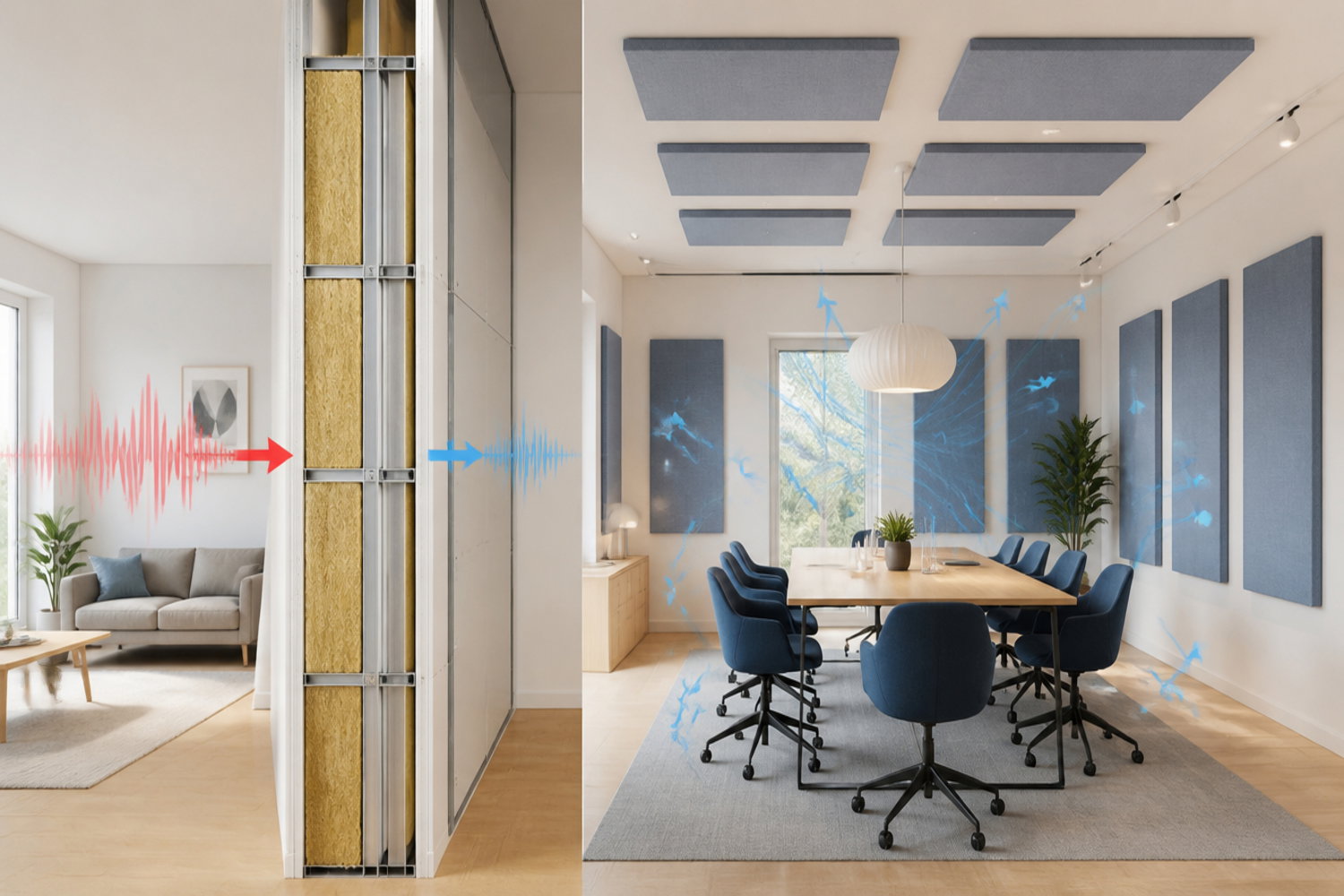
The difference between sound insulation and sound absorption becomes clearest when you consider the path of sound. Sound insulation involves reducing sound transmission through structures. Sound absorption involves reducing sound reflections inside a room. Both can improve a sound environment, but they do so in different ways and should therefore not be used as if they were the same solution.
1. Start by identifying where the noise problem is coming from
First, ask whether the sound is coming from another space or if it’s occurring inside the room you’re in. If you hear neighbors, traffic, music from another room, machines on the other side of the wall, or footsteps from the floor above, it’s often a matter of sound transmission. In that case, you need to consider sound insulation. If, on the other hand, the room sounds harsh, echoey, noisy, or makes it hard to carry on a conversation even though the sound source is in the same room, it’s more often a matter of sound absorption.
2. Understanding What Sound Insulation Is
Sound insulation involves preventing sound from passing through or around a building component. This can apply to airborne sound—such as voices, music, and traffic—as well as vibrations and structure-borne sound transmitted through materials. Effective sound insulation is typically based on several principles at once: mass that dampens sound energy, airtightness that prevents sound leakage, and decoupling that reduces vibration transmission between materials. A heavy but non-airtight construction can yield poorer results than expected, since sound can find its way through small gaps, joints, and penetrations.
3. Understanding Sound Absorption
Sound absorption means that sound energy inside a room is absorbed by sound-absorbing materials instead of bouncing back and forth between hard surfaces. This reduces echoes, reverberation, and sound reflections. The result is often a room where speech becomes clearer, the sound level feels calmer, and the environment feels less stressful. Absorbers are therefore often used in offices, schools, restaurants, studios, home offices, living rooms, and other environments where hard surfaces create a cluttered soundscape. For general sound absorption, SilentDirect typically recommends starting with the ceiling, since the ceiling is often a large, unobstructed surface and can effectively improve the room’s acoustics.
4. Remember why sound absorbers usually don’t solve noise from neighbors
A sound absorber can make your room less echoey, but it does not typically soundproof the wall shared with your neighbor. If the disturbance is coming through the wall, the wall itself, the joints, the gaps, or adjacent structures need to be addressed. An absorber on the wall can reduce reflections in your room, but it does not stop sound that is already passing through the wall in the same way as a soundproofing structure would. This is why many people find that even after installing acoustic products, they can still hear neighbors, traffic, or sounds from other rooms.
5. The Most Common Misconception
The most common misconception is that the term “sound damping” means the same thing in all contexts. In everyday language, “sound damping” can be used to refer to both sound insulation and sound absorption, but technically, it’s important to distinguish between them. If sound needs to be blocked between two spaces, sound insulation is required. If the sound needs to be softer, clearer, and less echoey within the same room, sound absorption is needed. When these concepts are confused, there is a risk of implementing an interior acoustic solution to address a structural problem, or of building a heavy sound-insulating solution when the problem is actually just reverberation.
6. Choose sound insulation when sound travels between spaces
Choose sound insulation when you want to reduce noise from neighbors, traffic, music rooms, utility rooms, machinery, laundry rooms, offices, bedrooms, or other spaces where sound travels through walls, ceilings, floors, doors, windows, or joints. In such cases, you need to identify the structure’s weak points. Tightness is often crucial, as even small gaps can allow air and sound to pass through. In building codes and new constructions, it’s also important to minimize direct, rigid contact between materials. When working with sound insulation and vibration damping, one of the most important principles is to decouple materials from one another. If different building components are in direct contact with one another, vibrations, structure-borne noise, and sound energy can easily be transmitted through the structure.
To reduce this transmission, the parts of the framing that come into contact with other surfaces can be fitted with a vibration-damping layer. SilentDirect Seal can be used at joints and contact points to help seal them and reduce the risk of vibration transmission. At joints and overlaps where a tight connection is needed, SilentDirect Aluminum Sealing Tape can be a useful accessory. If the goal is to block airborne sound, SilentDirect MLV can be part of a sound-insulating solution where high mass and sealing properties are important.
7. Choose sound absorption when the room echoes or sounds harsh
Choose sound absorption when you want to reduce echoes, reverberation, and sound reflections within the same room. This could be an office where conversations blend together, a classroom where the noise level becomes tiring, a restaurant where voices bounce off hard surfaces, or a living room with lots of glass and bare walls. In these cases, the primary goal isn’t to prevent sound from passing through the structure, but to improve the acoustic environment where you spend time. Ceiling absorbers like PES ceiling or wall absorbers like PES wall can be used to reduce reflections and create calmer acoustics.
8. Combine sound insulation and sound absorption when both problems exist
In many real-world environments, both sound transmission and poor acoustics are present. A studio may need sound insulation to prevent music from disturbing others, but also sound absorption to ensure the recording sounds controlled. An office may need better sound insulation between meeting rooms, but also absorbers in open areas to reduce background noise. An apartment may need thicker doors or better wall construction to block out disruptive noise, but at the same time, it may require acoustic treatments in a room with hard surfaces. This combination is often effective, but the order matters: first, determine whether sound is leaking between spaces; then, assess whether the room also needs improved internal acoustics.
9. A practical example illustrates the difference
Imagine a home office where you’re bothered by two things. First, you hear the TV from the room next door through the wall. This is a sound insulation problem, since the sound is passing between two spaces. Here, you need to examine the wall’s construction, gaps, doors, joints, and any potential sound leaks. Then you notice that your own room sounds echoey when you speak during video calls. Your voice bounces off the walls, ceiling, and floor, and the sound feels harsh. This is a sound absorption problem. In this case, sound absorbers on the ceiling or walls can improve the acoustics, but they won’t solve the issue of TV sound from the next room on their own.
10. How to determine which solution is right
Perform a simple listening test. If the sound is clear even when you’re silent and seems to be coming through a wall, door, window, floor, or ceiling, start with sound insulation. Look for weak spots such as cracks, gaps at the bottom of doors, penetrations, thin panels, or hard contact points. If, on the other hand, the sound is primarily perceived as echoing, rumbling, or unclear when people are talking or activities are taking place in the same room, start with sound absorption. In that case, it’s important to assess surfaces, furnishings, ceiling height, and the amount of hard materials.
11. Brief Conclusion
Sound insulation reduces sound transmission through or around structures. Sound absorption improves the acoustics inside a room by reducing echoes, reverberation, and reflections. If the problem is neighbors, traffic, or sound traveling between rooms, consider sound insulation. If the problem is that the room sounds harsh, noisy, or echoey, consider sound absorption. When both problems exist, the solutions can be combined, but they are not interchangeable.